Merry Christmas From Langley James IT Recruitment

An economic boom is on the horizon. Don’t delay your recruiting plans – act now or risk being left behind.
A little direct? Perhaps, but it is all too common at this time of year for businesses to start planning for the New Year, instead, take action now and start your recruitment campaigns now putting you ahead in January when many more businesses will then begin their recruitment campaigns.
2021 is set to be one of, if not, the most competitive years, when many projects that had been delayed will be caught up with. Morgan Stanley projects strong global GDP growth of 6.4% for 2021 while the excitable mainstream media predicts the start of a “roaring twenties” era for us all. With so many sectors expected to rebound at the same time, never, in modern times at least, has the commercial playing field been so level for so many. Titans will fall and minnows will rise as our riled and turbulent economy starts to settle into a fresh new order.
The question is, are you ready for the most aggressive commercial race of our age?
If most markets are set for simultaneous phases of rapid growth – being first having never mattered more. In critical areas of the IT recruitment market, COVID-19 has had little effect on talent shortages and so, come 2021, after the initial feeding frenzy is over, do not expect IT recruitment to be easy or less time-consuming. The best advice is to act now and get in touch with us before the frenzy begins.

Don’t be lulled into a false sense of security believing that rising unemployment means it’s a talent buyers’ market. Sure, if you are recruiting a team of production operatives or account managers, then yes, you’ll be able to simply post an advert and watch the CVs flood in. However, if you are chasing a first-class .Net Developer, BI Analyst, or Cloud Infrastructure Engineer you’re in for a shock. In 2021, demand for niche talent will rise sharply making it even harder to attract and secure the best people. Even if you are not quite ready to recruit, act now, and start the process. Contact Langley James in advance to start building talent pools and setup some early conversations to get ahead of the game.
2020 has caused hiring freezes, multi-signature procurement decisions, and cautious, fear-driven process extensions. In short, current business action is slow. Most recruitment assignments that do make it past the ‘sign-off’ stage are faced with increased process stakeholders, extended candidate interview hurdles, and general hesitation. Given what we have discussed above, how competitive do you think your recruitment process is?
Let’s be clear – you are competing with Hiring Managers with flexible budgets and the power to offer a candidate a job during or immediately after an interview. In talent, short areas such as IT, skill assessments, psychometric testing, and 3+ interview stages are luxuries that will slow you down and significantly reduce your chances of securing your candidate. We’re not saying make knee-jerk, ill-informed decisions. Far from it. Instead, be very clear on what you need, what you’re able to compromise on, invest time into creating a robust, high value but lean interview plan, and prepare to make offers quickly should you need to.
Before the sign off stage, talk to us at Langley James about the market and local talent competition. In skill short, high demand niche areas, failing to plan for recruitment competition is foolish. Assuming that going back to your management team, post-signoff, for more money is undesirable, pre-empt the inevitable with an offer strategy that includes an ability to negotiate and raise offers. In 2021, competition is going to be fierce.
To ensure your salary budget is in line with the market have a look at our salary guide which we publish monthly, these are the average salaries of what candidates are seeking and roles are advertised, you may need to consider paying more that the average, but we understand that is easier said than done as it may knock out the whole IT department salary budget.
While you read this, your employment competitors are already plotting to attack the talent market, which will include them trying to entice your staff. They too have powerful recruitment partners with extensive candidate networks and persuasive pitches. Putting off your battle plans until the new year gives them the advantage. By the time you’re ready to hire, they will have already engaged the market and may have already met many candidates some of which may be your own staff. Our advice is to start planning today and start taking decisive action.
Bottom Line – It’s December 2020 right now with plenty of working days until the 24th so, get ahead of the rat race and meet some candidates while they are available. With digital interviewing, it has never been so easy to put an hour aside to talk, so call Langley James and make a start. You will not regret it.
Give real thought to your existing processes and talk to us about them. They are meant to make your business run smoothly and efficiently so if your recruiting process is slowing you down causing a commercial disadvantage, consider changing it. The process is not law and is yours to change!
Speed is of the essence. Take action today.
IT Contractor interviews are different than interviews held for a permanent employee. Generally, line managers will not be carrying out psychometric tests, or second and third interviews. As a line manager, you may only have an hour to assess whether to hire the contractor.
In the interview, the IT contractor is likely to sell their skills, professional contractors are normally well prepared, knowing they have about an hour to win the contract.
As a line manager, you will be analysing if the IT contractor has the right skills, experience, attitude and personality to fit with the existing team and whether they have sufficient skills and experience to warrant their fee.
If a line manager invests time in getting the most out of the contractor interview, and remember that they are not recruiting an employee, they are probably more liking to make more effective contractor recruiting decisions.
The IT contractor has been invited to interview because their CV ticked all the boxes, but CV’s can be misleading by asking the right questions a line manager can identify if the IT Contractor is right for the project, recruiting the wrong IT Contractor can be an expensive mistake.
Line Managers should consider asking the following questions during an interview with an IT Contractor
During the interview, a line manager will also establish if the IT Contractor has strong communication skills. The main factors they will look for include;
A good IT contractor will have the same checklist to work through from their perspective and will be trying to reassure the interviewer that they are the best person for the job.
As a line manager, you will be likely to recognise during the interview that the contractor might not be the right person for this particular contract, or that they might not fit in with your organisational culture. Common warning signs include:
IT contractors that have long term successful contracting careers will also have good selling skills in addition to their core expertise.
At the end of the interview, an experienced and prepared IT contractor will normally ask for the business and attempt to close the deal, assuming of course that they want to work on the project.
As a line manager if you are not ready to make a decision at the interview you can schedule a time to get back to the, however, remember that a good contractor, even in depressed market conditions, will almost certainly have other options. So, do take time to deliberate over the decision, but do not prevaricate.
Once the contract offer has been made, the negotiation stage begins once again preparation is very important.
Langley James IT Recruitment has been established since 1999 and specialises in recruiting IT Contractors throughout the UK across all business sectors contact Langley James on 0207 788 6600
As we race towards the end of a somewhat eventful 2020, we’ll soon be bracing ourselves for the annual surge in people all over the country reflecting and deciding to change jobs. Twice a year, in January and September (ish), people return to work following a break with new-found and ambitious plans to further themselves and their careers. With less than a month to go before Christmas, here are some immediately actionable IT staff retention ideas highlighting what to address before it’s too late.
It is human nature that we want to better ourselves. The strive for growth is a natural progression all employees go through during their careers. It would be unrealistic to expect an employee not to toy with the idea of moving on to a better position, whether it be within your company, or elsewhere, no matter how loyal they are. Internal flexibility is a favorable attribute that, if you have the means to implement, is likely to enhance employee retention.
This is the idea of being open to moving employees around and letting them find their talents and discover what they are best at. You may find that an employee you originally placed in one role, finds their niche and performs to a higher standard elsewhere just by giving them some flexibility to try their hand at new projects. Obviously, it is not always possible to offer that level of flexibility to employees, depending on the size and scale of the business. In this case, challenge your staff, and provide them with a higher level of responsibility. This will alleviate the tedium and create a feeling of purpose and worth.
Although it may be frowned upon by some employers, it should come as no surprise when people say they would prefer to work only standard or flexible hours so that they can spend more time focused on other commitments.
It can be easy for employers to overlook the bigger picture – a poor work-life balance will not only impact employee but their spouse, family and many other aspects of their life. According to the Mental Health Foundation, over a quarter of employees in the UK feel depressed due to their work-load, and a further 58% feel irritable because they struggle to maintain a healthy work-life balance.
Workload plays a significant part in employee satisfaction and ultimately can influence an employee’s decision on whether they stay or leave. Projects are often time-oriented, do not assume that if an employee continues on with tasks beyond scheduled working hours that it is because they love their job and want to be there, which of course can be the case, but not in all instances. A feeling of pressure will profoundly impact upon an individual and force them into working beyond their contentment. If an employee is showing signs of stress and continue working beyond what is expected of them, then perhaps it is time to discuss with the individual ways to manage their time more effectively.

Measuring how appreciated an employee feels is one of the most difficult things to gauge, but one of the most important. According to a recruitment survey conducted a few years back, a simple “thank you” to your employees is worth £1,608 a year. Lack of recognition or appreciation can cause an employee to feel undervalued and unsure of how they are performing, which can ultimately lead to anxiety and stress. People perform to a much higher standard when they feel valued and a boost in confidence can have a staggering impact on the standard of work produced by your employees. If you are finding that employees are disengaged, yearly appraisals simply will not suffice. Higher engagement levels will greatly benefit both you and your employees. Making small alterations such as implementing an open door policy, and setting goals and targets for your staff to reach, will get conversation flowing, and feedback and recognition can be easily carried out.
This is the age-old tale of someone who has taken a job with certain expectations, and has been left feeling disappointed, or worse, misled when the role they undertook was not as it was expected to be.
As a recruitment agency, when we ask why people are looking to move, a large number respond with “the job didn’t meet my expectations”. Often the problem is that the job description that was presented to the employee doesn’t match the role. The ambiguity of a role prior to an employee starting with your company can be far more critical than you would anticipate. People place a large amount of trust in the employer to provide them with the most accurate depiction of what they will be undertaking as part of their new role. Often it can simply be that the employee has misunderstood the job role, however, sometimes the employer has deliberately misled them into a job.
To prevent your employees from making a move, take measures to ensure that they have a clear picture of what is expected of them. If you have a resentful employee, address it now before the situation becomes irreversibly toxic.
If someone is feeling dissatisfied with their ability to complete their duties due to lack of knowledge, satisfaction levels will suffer and you are likely to lose them from your team. Providing training and development at work poses great benefits to both you and the employee. It is crucial in keeping your employees engaged while, at the same time, benefiting you with duties and tasks being completed to a greater standard. Enhancing knowledge through the appropriate training will increase confidence, and ultimately help you to retain staff. It will give the employee the opportunity to address weaknesses and to improve on those weaknesses before they make the decision to leave on their own accord.
The bottom line – ignore these things at your peril. It can be easy to miss the red flags, especially if you have a large team, however, staff job satisfaction is an emotional issue and requires an emotional, empathic response. Best advice would be to assume that everyone might be dissatisfied and to explore everyone’s situation equally. Tackle it now and you stand a good chance of cooling your staff’s motivations to leave.
We will look back on this time with curiosity post-pandemic when future economists tell their children’s children about a time when there was a 15% rise in GDP (Gross Domestic Product). They will also remember the quarter before when there was a massive 19.8% drop inconsistency, however, this is not a common occurrence and for that we are grateful.
While it’s fair to say that our economy has been erratic recently, there are some positive elements to take from the pandemic. For one, the job market itself has remained fairly resilient.
Despite the fact that official unemployment figures have risen by 4.8%, which represents a total of 1,620,000 individuals, peak unemployment records are predicted to be lower than that of previous recessions Britain has endured. This may be attributed to Britain’s ‘flexible’ job market; particularly when compared to its European counterparts. To put this into perspective, unemployment in the UK peaked at 11.9% throughout the 1980s, 10.7% in 1990’s and 8.4% in 2010 following the financial crash.
It’s true the news surrounding the 95% ‘effective’ vaccine has had a huge impact on businesses’ confidence, which, combined with the UK’s flexible labour market, is reassuring signs that a bounce-back post-Covid-19 will see Recruitment levels recuperate quicker than other decades.
Other examples of the resilience of the job market are the number of jobs currently being advertised. The ONS showed a 146,000 vacancy rise during August-October, and CV-Library found that job postings in this 2nd English Lockdown (November 2020) were 88% up on the levels of job vacancies advertised in March 2020.
More businesses are learning to work differently and are now recruiting remotely, interviewing virtually, and onboarding new employees without meeting them. Some say the “new normal?”
At Langley James, we have experienced a steady and increasing flow of vacancies since June, despite local and national lockdowns. Indeed, savvy employers are aware this is a good time to find new blood for the IT projects.
IT professionals are also keen to see what opportunities are out there without jeopardising their current job security. They will contact us to discuss what roles we have and may not necessarily always apply for IT roles in the traditional manner.
In summary, despite the current spike in unemployment, good candidates, especially highly skilled IT candidates, are not necessarily easy to find. Advertise your role directly and you will be inundated with responses, and most likely not the candidates that you are looking for. As an established IT Recruitment Agency, Langley James can find you your next employee that may not be responding to adverts.
Langley James specialises in IT Recruitment throughout the UK our specialist teams cover IT Infrastructure, IT Development, IT Contracting roles, Cybersecurity, Data Analysts, IT Managers, IT CIO’s and IT CITO’s contact Langley James to deliver your next IT vacancy or IT Contract Recruitment Vacancy. We can help you to recruit someone worth recruiting.

Unquestionably, the coronavirus crisis has dramatically shifted the way society functions on a global scale. The undue stress and anxiety caused as a result of the virus have had a profound impact on the world – a notion exacerbated by the increasing toll of lives lost from this disease.
Naturally, as social distancing measures are implemented in order to keep the public safe, humanity – and businesses as a whole – have relied heavily upon technology. Consequently, tech companies have experienced some major positives in the age of COVID-19.
Langley James has looked to find the positives that came from a very bad negative. These findings are summarised below;
The move from office to remote work has surprisingly revealed to businesses the effectiveness and potential of a primarily remote workforce. A study found that 82% of business leaders say their organisations plan to let employees continue to work from home at least some of the time, while 47% plan to allow employees to do so permanently.

The transition to working from home to both business hardware, specialists software, and cycle security has demonstrated the ability to work flexibly and subsequently save employers money on office rental, heating, and supplies. Most employee have found that they are financially better off with less money being spent on fuel, luches and clothes and having the flexibility to walk their dog, particpate in the school run and spend more time on domestic projects.
The pandemic has been a catalyst for many silver linings, one of which is the emergence of new entrepreneurs. Around a quarter of those who were made redundant due to COVID-19 were starting their own businesses. In the survey, Those who said they didn’t have plans to start a business pre-pandemic, do now; 51% said they identified new business opportunities due to the crisis.
The majority of sectors these entrepreneurs were venturing into mainly involved the hospitality, arts, and entertainment industries – a surprising finding considering these occupational spheres have been one of the worst affected as a result of the virus.
Every day this pandemic is driving customers to think and work differently.
In light of the current climate, there has been a much-needed interest and increase of production tools across a variety of businesses.
Productivity is typically one of the most difficult things to measure. Striking a balance between monitoring employee productivity and allowing them space to be autonomous can be challenging. For example, financial giants Deliottes have published a report detailing their extensive implementation of online collaboration tools (such as a virtual KANBAN* board, virtual task list, etc.) to keep track of tasks that are outstanding, in progress, and completed across the team. These technological tools are now more important than ever with a limitation of social contact, facilitating team and individual productivity within the workplace.
Another major finding is the increased and independent distribution of cybersecurity for insurance coverage to small and midsize businesses “at speed”. This speedy rotation may be attributable to the 100% move to online, as opposed to the traditional paper-based model.
At the start of the COVID-19 pandemic, many organizations had to rapidly pivot from work in the office to a fully remote structure. While some were well prepared and able to accommodate such a shift, others were scrambling, increasing cybersecurity risk. The concern for insurance companies was how easily these companies were able to transition and whether they were able to do it securely.
Consequently, it seems the COVID-19 pandemic may prompt a lightbulb moment for a lot of organizations that cybersecurity risks should be front and center. As companies become increasingly reliant on technology to run their business, it should raise questions as to what happens if that technology fails. Cyber insurance acts as a backstop to be able to protect organisations from a system failure standpoint, yet less than half purchase a standalone cyber policy. Overall, this is accelerating the adoption of cyber insurance.
There has been a need for “accelerating digital interactions”. What this means is that in order to effectively communicate and interact online, companies have needed to open their data and services to their stakeholders through the medium of integration technologies.
Indeed, recent data highlight how consumer and business digital adoption has accelerated 5 years forward in a matter of around eight weeks in sectors such as Banking, who have transitioned to remote sales and service teams, and launched digital outreach to customers to make flexible payment arrangements for loans and mortgages.
Continuing the theme of openness, surprisingly, consumers have been more willing to share their data during the pandemic, to provide companies with vital information about their gender, ethnicity, age, sexual orientation, post code, tv channels watched, and specific programs they watch. All this data has been obtained from the “Privacy + Privacy” study regarding consumers’ concerns about gathering data. The findings are summarised below;
For instance, a majority are somewhat or completely willing to share data on each of the following:
It seems that we have been able to cultivate some major technological advancements within the business sphere as a result of COVID, which is likely only to accelerate as we adapt to our “new normal”.
Employees leave managers, not companies. At least that’s what they say but is it true?
Perhaps. What is certain, however, is that of many of the reasons cited by people leaving their jobs, the vast majority stem from issues concerning the management, be it directly or indirectly. Money, benefits, training, technology, processes, progression, culture, and so on, are all in the hands of managers to influence or change. However, these are relatively easy things to improve upon, if motivated to do so.
Worse offenders are the common management behavioral traits that frequently cause people to update their CVs.
Pulling insight from all corners of our candidate interviewing experience, here are 3 classic managerial approaches that routinely upset team members and sometimes cause them to seek alternative employment.
When people join a company, they do so fully believing the dream sold by the hiring manager during the interview and offer stage. Naturally, plans change and unforeseen events occur which can hinder a manager’s ability to make good on their promises, but all too often senior dreamers get carried away in interviews, appraisals and other meetings with a lot of promising, exciting talk without any real ability or intention to follow through.

Guess what? People don’t like to be let down and when it happens, they talk about it. Not just internally either! To their friends, family and worse, their next series of competitor interviewers and later, with their new boss and colleagues, eager to hear the gossip from a rival. Times that by the number of people a manager has disappointed and, over time, the numbers really add up. Before you know it, the company has a reputation for making false promises making it hard to attract and retain staff.
A manager stealing an idea or taking unearned credit is a low, selfish and shameless punch below the belt for anyone to experience and yet, its surprisingly common. Victims are left helpless, often unable to prove otherwise, and even if they can, what further suffering would lay in wait for them if they dare make a challenge? So, they back down, lick their wounds, update their CV and leave.
So, now the short sighted, glory hunting manager has lost yet another valuable, creative professional capable of innovation good enough to impress the brass. Well done!
Most managers are impatient, especially those in charge of other managers, and are tolerated because often their impatience breeds pace and often returns results. However, the line is thin. Should they push their staff too far, they quickly become an over-communicating pest seemingly hell-bent on hourly distraction, like an overly enthusiastic back seat toddler. The stress this causes can quickly become intolerable and will, 100%, result in resignations. Management isn’t about head pecking. If it were, they’d be called Head Peckers, and aptly so.
The bottom line: Management styles vary greatly, each with their own set of pros and cons, however, how a person responds to lies, aggression, manipulation and disrespect is universal. Seems so simple! Ironically, many managers are blissfully unaware of the damage they’re causing to their own success by subjecting their own staff to these kind of behaviours.
Sorry to burst your celebratory bubble but the game is still on! Research by The Wynhurst Group found that a staggering 22% of staff turnover occurs within the first 45 days of employment. To make matters worse, those stats don’t include candidates dropping out before their start dates. Shut the front door I hear you say!
Eager as you may be to move on, the period between the candidate’s acceptance and start date is fraught with peril. Avoid an ‘out of sight, out of mind’ attitude and plan to avoid the predictable risks of inaction.
Here are a few of the major pitfalls and some ideas to help avoid them.

If you think your chosen candidate is great, so too will other people including current bosses, recruiters, ex colleagues, network connections and of course, other rival employers. Even the candidate’s own sense of entrepreneurialism can derail your plans. With so many people working from home now, in the daily habit of job searching, the threat of losing them is very real.
Your best weapon against all of them is speed. On the day of offer, strike while the iron is hot by having the offer letter and contracts ready to send, ideally by both email and post. Help them to feel part of the team at this early stage by ensuring the letter contains warm, welcoming details describing the plan, before and after, their start date, including any special instructions for remote working if appropriate.
Encourage them to resign at the first opportunity by asking for a start date commitment and keep in touch throughout their notice period. If you’re using an agency, check the consultant is in touch with the candidate too.
Your desirable candidate is good and will likely be offered more money to stay with their current employer. Remember your own recruiting headaches – Even if the company is upset by the resignation, it is often cheaper and easier to increase a salary instead of the expense and effort of recruiting someone new. Expect counteroffers.

Counteroffers can generally be beaten simply by making a good offer in the first place combined with a challenging and exciting career opportunity. Generally, people move for emotional, career-focused reasons and not for money however, the salary is still important. Offering someone a like for like salary leaves you wide open for a challenge. Ensure the whole package is appealing to ensure your candidate won’t be talked into staying. Wise employers keep some of the recruiting budgets aside just in case they need to increase the offer.
Before starting a recruitment campaign, think about the end and map the process journey in between. The end, by the way, is when a happily inducted, settled and well performing employee successfully passes their contracted probation period. Depending on your contracts, this may be up to 6 months. Plan events for every stage from casual team introductions to more involved professional meetings during the notice period, first day induction, job objective setting, reviews and appraisals. Stick to the plan and pay attention to red flag signals of discontent. Addressing issues quickly will help to overcome any risk.
For a new starter, there is nothing worse than feeling like an afterthought on day one. Book time to properly prepare for your candidate’s first day and ensure all required personnel is informed and equally prepared ahead of time. Ideally, include an induction timetable in the welcome letter with clear instructions on what to expect. Remote starters are more challenging, so ensure they are made to feel welcome. We have seen companies set up a ‘buddy’ system rota with a select group of colleagues who can help and guide your newbie through their early days. WhatsApp groups, teams, etc are just some of the digital solutions you might consider.
Avoid the classic unprepared faux pas by arranging for all equipment including pens, phones, computers, etc are with them, ready to use before the candidate sits down on day one.
If they are working on-site, don’t let them loose at midday to find their own way. During the morning, invite them to join you and/or members of the team for lunch to immediately build rapport and allay any social fears.
Be imaginative with your welcome approach. Google search some ideas of what others have done. You might be surprised!
16.45% of all candidates leave their job within the first week due to a ‘bad’ first impression.
During the first 45 days, your new employee is constantly assessing, comparing, and judging the reality of the job versus the dream-like picture painted during the interview process. Don’t allow their polite reluctance to complain to lull you into a false sense of security. Find out.
Create opportunities for open conversation and encourage honest feedback throughout the induction process and beyond. Address issues as they arise and take immediate action where possible to demonstrate your desire to support them.
Manage expectations. It’s the secret to the whole show. Meet commitments, be honest about the job and company culture, and stay in touch with them as much as possible.
Some of the biggest challenges for employers managing remote teams, often for the first time, include workers struggling with loneliness, managing their time, and communication among staff members.
What’s more, as the government starts to impose tougher restrictions ahead of the ‘second wave’, companies may be forcing their staff back to the remote environment.
While this all can be tough, finding a practical strategy that works can help you and your team make it through these trying times. Here are a few points that some of our homeworking managers have shared with us that might offer some much-needed wisdom!
While many of us may have acclimatized to the remote working lifestyle by now, a large proportion of the job market have been trust back into the office environment again after following government orders. Consequently, transitioning back into remote working is a difficult pill to swallow for managers and employees alike.
Make no mistake, inexperienced remote workers have been suddenly thrust into unfamiliar working environments and their daily routines are all over the place. With that in mind, ensure you give your team crystal clear expectations of what you want them to achieve. Clear direction from you takes the pressure off them and helps everyone to know what success looks like to you. It may be worthwhile weighting their job descriptions if the balance has shifted due to home working so your team understands what aspects of their role takes priority.
If your team were in the office, would they have regular access to you? If that is the case, things should not change for them when working from home.
At the start of working from home, you may have had to contact your staff on a regular basis to avoid any feelings of loneliness/isolation, until things settled down. While you and your staff may be in the swing of things, it’s still extremely important that a clear line of communication is continued and you manage your staff as if they were in close proximity to you.
People need to feel part of the team, now more than ever.
We’re probably all sick of the thought of Zoom meetings (both in a professional and personal capacity), but truly, what would we do without it?
We are very lucky nowadays to have so many communication options available to us. Using video conferencing is a really inclusive way of holding a meeting with your team Microsoft 365’s Team, Zoom, and Google Meet amongst many others are great ways of very easily holding a face to face team meeting. Telephone Conference calls, Facetime and Skype are other ways to keep in touch when you can’t physically meet with your team. Whatever you choose, try to forge an inclusive contact plan that offers everyone consistency, routine and the chance to be heard.
Notice one of your team is not themselves? Follow up with a call and use Video-Based Coaching to help them, regular contact will help you spot such issues. Working alone from home is not for everyone. For some, being alone all day is their idea of hell while others are more than happy in their own company. Keep in mind that everyone tends to offer a brave face – be careful not to ignore the signs.
A particularly useful method we have employed here at Langley James is employing a ‘buddy-up’ system, whereby two employees maintain regular contact and catch-up with one another.
Maintain focus by setting objectives and use a progress monitoring system to keep people on track. It’s vital your team understands why you need to follow their progress to avoid feelings of distrust. Instead, this is about the business remaining on course for success while helping you to foresee any issues, offer extra support or opportunities to improve the process.
You might feel unsure as to whether the work will get done to the same standard as if they were in the office. To cope with this, set up work-from-home guidelines, e.g. emails must be responded to within 24 hours e.g. use text for urgent matters, e.g. no calls between certain hours to make sure teammates are not working around the clock e.g. limiting social media usage etc. Set the rules and trust the team to follow them. If they don’t, it’s easy to refer to the rule and avoid conflict and negativity.
With this being said, the same rules apply for employees who are working overtime. Indeed, many employers are finding that their staff cannot switch ‘work mode’ off after hours. It’s hard when your computer is just sitting there. The temptation to answer emails and calls on a Sunday evening has become a frequent occurrence for many of the working-from-home army in recent months.
With no-scheduled holidays to look forward to and an impending second lockdown on the horizon, it’s important to remind your staff that they need to avoid those feelings of ‘burning out’ and ultimately ‘switching off’ when the day is done.
Ensure that any news in the business is always circulated to home workers at the same time that the rest of the team are being made aware. There is nothing quite as demotivating as finding out a business critical decision from someone else in the business who was made aware before you – frankly it just makes people feel second class.
Remember, this peculiar remote environment employees have been thrusted into will have mental implications for many – with feelings of anxiety, stress and loneliness at its highest. This is only exacerbated by the economic effects as a result of the virus, with many employees fearing that they may be made redundant. The remote work is likely to make staff overthink about their position within the company, so being as open and transparent as possible will be crucial for work productivity and morale.
Ensure that home workers still feel part of the overall company vision and how they fit in. To work productively people need to know that their efforts are contributing towards the overall goal. Yes, this crisis might have thrown a cat amongst the pigeons and changed the short/medium term vision, however that change needs to be properly communicated to maintain motivation and focus.
Ensure your team has the tools to do the job. Broadband is absolutely critical for most of us however, connection reliability may be an issue, especially in more rural areas. Suggest alternative venues for employees struggling with this issue such as working with other colleagues, friends or family. Look for alternatives like Dongles, mobile phone hotspots, etc and try to offer solutions instead of problems for your staff to solve.
Managing a productive team remotely begins with a strategy for communication. Be aware of how disruptive ‘over-communication’ can be to your day and set out a process so your team knows when it’s appropriate to call you. First, arrange for the appropriate number of weekly formal “report-ins.” Second, set guidelines about daily needs. Some people work better with a shopping list of questions and thoughts while others like a trickle. An understanding of what is urgent will further mitigate inefficiency, allowing ultimate productivity, maybe asking team members to question “ Is it Urgent?” or can it wait. Encourage email or instant messages for less urgent issues reserving phone call interruptions for the meaningful stuff. That all said, be aware that some of your team may need reassurance or guidance to be productive so assess on a case by case basis.
Empathise and appreciate your team member’s life by discussing family, commonalities and shared beliefs you employees would normally discuss this in the office with their colleagues, its worthwhile investing this time in getting to know them. Show you are supportive of their success by using inquiry to help them achieve their goals rather than check on their progress and numbers. Avoid closed questions like, have you done X?, or did you manage to call Y? You have no idea what they have had to deal with and so, if something has interfered with the plan, the only answer they can give is negative resulting in humiliation and defensive confrontation. Instead ask, What progress have you made on X? or, How’s your morning been? Qualify the situation first and then ask more detailed questions.
Ensure that everyone gets to know about achievements and make a real fuss, it will create a team feel good factor and let us face it we all need some good news at this unusual time!
So, there you have it. Some really useful advice from people who’ve been through the highs and lows of remote working before. Welcome to the new normal!
Our expert IT recruitment consultants are here to take the pressure off you when recruiting someone new, permanent or contract. We liaise with candidates with the utmost care to ensure that their candidate experience is a positive one. Call us on 0207 788 6600 and let us help you Recruit Someone Worth Recruiting.

With this being said, the function of businesses needs to reconvene as usual. Businesses still need to interview and onboard candidates. Although, for the safety of both candidates and employees, this will be done remotely.
Besides getting over a few technical glitches and frozen faces on video conferencing calls, businesses need to consider how they can appropriately interview candidates in the most effective and efficient way. Whether it’s establishing clear communication channels, being extra prepared for the interviews or keeping in close contact with candidates throughout the remote interview stages, there’s a few things businesses should implement when interviewing remotely. To help, we have compiled a list of the top tips for remote interviews.
When interviewing candidates face-to-face, employees will be able to quickly gauge the individual’s personality based on first impressions. Unfortunately, remote interviews can form a barrier and prevent companies from gaining an understanding as to whether this candidate is desirable for the job role itself. Social cues such as body language and facial expressions are hindered during remote interviews, which can typically make or break a candidate under normal face-to-face interviews, making the remote hiring process that bit more difficult to narrow down.
Consequently, establishing a clear line of communication is integral for a successful remote interview. A company should consider the different types of remote tools they should use to hire candidates at the different interview stages. For example, a phone interview could be a great hiring communication tool at the first stage, to quickly narrow the candidate pool down. For the later stages of the interviewing process, technological tools that facilitate video conferences with multiple people may be your best option. Platforms such as Zoom or Microsoft teams are useful for this, as you will be able to see the candidates facial expressions and hand gestures as well as having a few members of your team on the call too to help interview the candidate.

As with anything, planning is key to a successful interview. Structuring your interview with the main objective and key questions is important for remote interviews. Not being able to see the candidates and freely speak to them in an unscripted and naturalistic way can be hard for both college and candidates alike. Consequently, having a template of questions to ask can ensure that the conversation runs smoothly and avoids awkward delays, whilst still being able to assess whether the individual has the necessary skillset and experience to fill the job role.
Top tip: start with the more simple and friendly questions to allow the candidate to open up and feel at ease. This will allow you to establish a rapport and bridge that gap that is prototypical of remote interviewing.
At this stage, it is also really important to be prepared with who you want in the interview too. Now that you have to onboard remotely, you have to be selective about who can join the call/ meeting with you. It’s no longer the case that one of your colleagues joins mid-interview. Most platforms facilitate 4 people max (unless you pay for pro), so pick the best colleagues based on the job role.
In light of this, the interview team should be prepared about who is asking what questions and in what order. It can be very easy to talk over one another when on conference lines, which can cause confusion and disrupt the flow of communication. Make sure you all have a structure and attempt to stick to it as much as possible. Obviously, there will be deviations, but having a structure in place can help facilitate a smooth remote interview process.
Working, interviewing, or even living remotely has its challenges. It can be very isolating (pardon the pun) to be stuck at home. This is only exacerbated by the current job market, which carries with it much uncertainty for candidates.
Consequently, it is important for you as an employer to stay in contact with your candidates and update them about the interviewing process. Let them know when they should expect a callback, or when the next stage of the interviews will be held. Keeping them in the dark can sometimes cause more damage than necessary, planting a seed of doubt in their minds – a damaging proposition if that candidate was someone you really liked!
Be communicative and provide feedback. If there is a delay for any reason, check in with your candidate to let them know you are interested but need some more time and give them a realistic time frame.
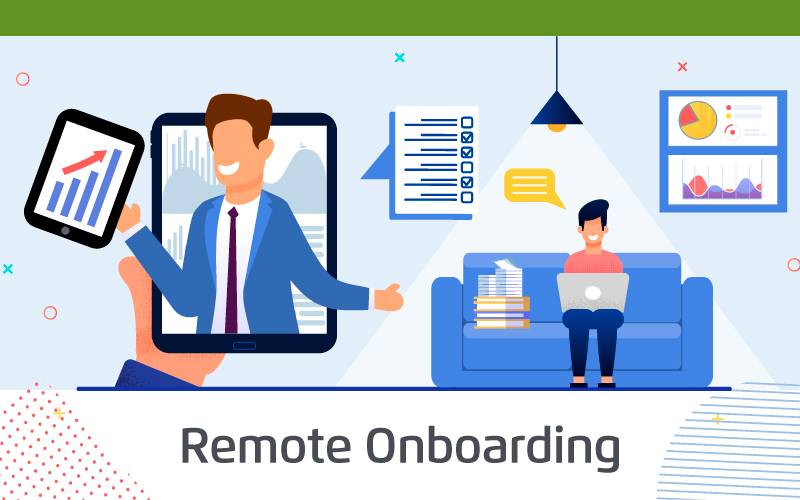
In light of this, it may be useful to create a pre-onboarding process for your new starter, presenting them with a digital welcome package that can be easily circulated via email or host on a shared digital drive. Do this a few weeks before they are due to start. This may seem self-explanatory, however, there is a large proportion of companies that do not have these facilities in place. While 63% of employers have staff working remotely due to COVID-19, only 43% have remote company policies in place. In order to facilitate the changing work landscape, you should prioritize creating one.
The welcome packages should cover your companies policies and guidelines, so they know what is expected from them within their new role, allowing them to digest key information about your business. You should also set out an itinerary for them for the first few weeks, with each day broken down and structured into morning and afternoon tasks.
The welcome packages should also contain a main point of contact. If your company facilitates a ‘work buddy’ or mentoring process, make sure to include this within the welcome package too, so that they can reach out to the prospective person prior to starting.
The pre-onboarding stage is also a key opportunity to ensure all the tech requirements are in place. If the employee requires a work laptop, phone or various office equipment, make sure to send this over with ample time to set up their remote workplace. Given the nature of the government guidelines concerning COVID-19, deliveries may take longer than usual, so preparing in advance safeguards you from delayed delivery slots.
Once the pre-onboarding process is complete, it is essential that your new starter has the necessary technological requirements expected to do the job role itself.
A desk, chair and computer is a prerequisite for most office employees when they join a new company. However, those candidates working remotely may not have this in their home. The pre-onboarding process should clarify what the new starter has and doesn’t have, which is then the responsibility of the employer to complete an ergonomic check and accommodate their technological needs.
It may be useful to set a budget for each remote worker when setting up a new home office. Present them with a list of office essentials.
Additionally, if you have a dedicated software specific to your company, make sure the candidate has access to a person who can set this up for them, as well as assist them in navigating the software. This can be organised as a set of meetings or in the shape of a dedicated online portal. Zoom / ringcentral or Microsoft team meetings are useful platforms to do this, as they have a function where you can share your desktop screen. It’s also free, saving your company money!
As aforementioned, if your company facilitates a ‘mentoring’ style of learning, then this can be an extremely useful way of onboarding a client remotely. In addition to providing extensive knowledge of the company, mentors can assist in facilitating the integration of a new starter within the company. They can act as a first-line of communication and can help with providing answers to the new employees’ questions.
Unlike office culture, working from home can be lonely and in some cases (pardon the pun) an isolating experience. A work buddy / mentor can act as that friendly face and help the new starter be immersed within the business culture.
By now, for those employees working remotely, your company will have established a line of communication to keep each worker connected. Skype, Zoom and Microsoft Teams have been integral platforms for a number of businesses to stay in touch and maintain usual business practice expected within the usual office environment.
While a new starter should have received a number of a specific person (i.e., HR manager) to contact during the onboarding process, other means of communication with a range of individuals within the company should be provided too. Setting up video conference calls with key members of the business is a priority during the onboarding process, as a way of decreasing any feelings of isolation. This will also help them understand the company ethos and gain a better feel of the company – understanding their brand values and how their role fits into the wider business strategies. They can also help build relationships with colleagues during various skype / zoom / microsoft teams conference calls.
It is always good business practice to schedule check ins with the new starter on a regular basis. A tip would be to get a member of the team / manager / buddy to pencil time aside to communicate with the employees, to ensure they are clear on the tasks at hand. This also provides a perfect opportunity to assign tasks and give feedback on the work the new starter has completed.
While it is essential that an employee makes a great first impression, it is just as important for this to be reciprocated by the company. Indeed, 11 percent of individuals have changed their minds on a job role after being onboarded. Sending a warm welcome is essential to encourage and motivate your employers that they have made the right decision working for your company. Let them know how excited you are for them to join the company and reinforce this with regular contact from a multitude of individuals.
Over 17% of employees quit after their job after the first week. Therefore, it’s important to make the employee feel relaxed and at ease when joining your company
Finally, make sure you set up a training program that will facilitate remote working.
It is important that induction training is varied to keep your new starter entertained and motivated. Endless days of compliance training, for example, will not be motivating! Ensure that your company’s employee value proposition is central to your training and do your best to bring it to life and make it relevant to the individual.
Make your training adaptable to the remote workplace. This could involve introductory videos about your business, team diagrams and short introductions to key personnel. The top tip would be to keep it varied and entertaining – refraining from a stagnant onboarding process.
Final thoughts…
Employers on a global scale are now seeing the huge benefits of a remote workforce. Despite the current pandemic forcing employees to stay within the confinement of their own home, it is predicted that nearly 40% of employees will continue remote work even after the pandemic is over. And we can see why! Companies are saving money exponentially on business premises and can recruit on a national scale – particularly those employees who have had previous experience working from home. They do not need to focus on candidates in the locality, as remote work facilitates onboarding on a global scale.
However, the trick is to ensure that your company is prepared for this. Being prepared and ready for remote working is essential to the functioning of your business. Follow these tips and you will be on the right tracks to onboarding amazing talent for your workplace. This is an investment that will surely pay off!
To enhance effective communication in-house, employers across industries are increasingly seeking soft skills during the recruiting and hiring process. In the remote work era, organisations are often compartmentalised, siloed into specific departments with minimal overlap between teams, however, developers, programmers, and IT professionals routinely must collaborate across the business structure to achieve common objectives.
Effective communication requires a host of considerations including the ability to clearly and concisely relay technical information. Mastering the art of brevity in communication is a helpful way to further boost one’s soft skill set.
“Soft skills are critically important for all professionals, especially those in a supportive function. IT professionals and programmers tend to be linear thinkers and goal-focused, but also, they have their own vernacular and their own technical language, pun not intended, that may not be easily understood by the people that they’re working with or serving,” said Cheryl Dixon, communications executive and adjunct professor, Columbia University.
To learn more about ways to deliver crisp, compact language we sought advice from a number of organizations across the communications and tech sector. Here are seven tips to help technical members of the workforce streamline collaboration and boost their soft skills.
As teams continue to work remotely during the coronavirus pandemic, many organisations are leveraging a spectrum of communication tools such as Teams, Slack, Zoom, and more. These tools lack the richness inherent in face-to-face communication further increasing the risk of indeterminacy. That said, one of the most imperative aspects of succinct communication is reducing the risk of miscommunication.
“Define your terms. Miscommunications often occur when people think that they’re talking about the same thing, but are talking about different things. By defining your terms, it can help ensure that everybody is on the same page when they’re talking about something,” said Max Boyd, data science lead at Kaskada.
Similarly, by defining key terms, you are able to more succinctly carry on a conversation without long explanatory parentheticals peppered into discourse. Additionally, if terms are defined on Slack, for example, the end-user now also has a ledger and reference point if they need clarification down the road.
Remember there is a difference between brevity and expeditiousness; haste may eventually require further remediation. Remember, with concise communication, each word carries tremendous weight, so make them count and consider their impact in advance. As mentioned, limited messenger platforms are prone to misinterpretations. Concise communication may require more forethought than a traditional in-person conversation.
“‘Concise’ doesn’t necessarily mean ‘quick.’ Taking a little bit of extra time to read and clarify what you wrote before hitting send—and understanding your objectives—will cost you a bit of time in the short term, but will pay back large returns on investment in terms of time spent reading and talking,” Boyd said.
At times, concise communication functions optimally with redundancy built-in. To do so, it’s imperative to routinely check in with your audience during the conversation. Before taking the next step, first make sure everyone is one the same page. Similar to defining terms, regular inquiry and mindfulness can decrease the risk of confusion.
“Ask questions to check in for understanding. When working with IT partners, people might feel intimidated or feel foolish if they don’t understand some of the technology — so they may not ask the questions they need to. So, checking in for understanding and comprehension as you go along is going to be key,” Dixon said.
Effective communication involves active listening and planning. Rather than waiting for your turn to talk or present a set of ideas, it’s important to listen carefully, keeping in mind the ideas presented during fluid conversations. Before stating a particular point, take pause to ensure you’re approaching the next step in a way that takes into account the other person’s points, while also moving toward the common objective.
In the age of daily video conferences and Zoom Fatigue, it’s imperative to engage the audience. An actively involved, attentive audience is more likely to be aware of the points being discussed and retain this information moving forward. Maintaining the listener’s attention will reduce the risk of needing to backtrack later in the conversation. Illustrating the various ways in which the ideas presented will directly impact a person is an easy way to accomplish engagement.
“Humans are innately biased towards ideas and activities that have a direct impact on them,” said Patrick Ward, director of marketing at Rootstrap.
“Rather than communicating every aspect of a particular issue, a better strategy is to identify the other person’s motivations and share information that is specifically relevant to that motivation and nothing else,” Ward continued. “This is not dishonest, and the other person is not awful for not caring: It’s simply a case that humans, especially within the tech industry, have an enormous cognitive overload and therefore must prioritise what they focus their attention on at any given point in time.”
Programming, development, and IT are hinged on discernible, duplicatable processes and strategies. While this concrete realm of standard operating procedures may not readily lend itself to the use of abstractions, the use of these devices and metaphors may help others understand complex material. The use of everyday examples can help technical teams break down complex information into more digestible portions. These concise communicative segments can illustrate a larger framework in a more approachable way.
“While a non-engineer might not understand what a SQL database is, we might still communicate salient points about the size or structure of our data by using concepts familiar to anyone who has used Excel. Similarly, we might compare full-stack feature development to the construction of a physical house, or we might compare a code review conversation to the process of editing a Google Document,” said Lusen Mendel, Karat director of Developer Relations.
Overall, organisations are a patchwork of departments brimming with various personality types. As a result, concise communication will need to be tailored for a particular audience. The communicative equation that works for one person may not necessarily work with another.
CEO of Avantra John Appleby brought up the DISC personality assessment tool. This system looks at communication in terms of Dominance, Influence, Conscientiousness, and Steadiness. These tests build a communication profile of sorts, enabling enhanced collaboration between different DISC “types.”
“If you’re having a conversation with someone who demonstrates ‘C’ style communication traits, be super precise in your ask, set clear expectations and lay out the deadlines. But, remember, this doesn’t define personality. It’s simply someone’s default communication style. A comfortable exchange would be one that’s structured and backed by facts,” Appleby said.
Our expert IT recruitment consultants are here to take the pressure off you when recruiting someone new, permanent or contract. We liaise with candidates with the utmost care to ensure that their candidate experience is a positive one. Call us on 0207 788 6600 and let us help you Recruit Someone Worth Recruiting.
People are inundated with information, and their brains have reached a saturation point. If you want to get someone’s attention, you must be brief, according to Joe McCormack.
There are three tendencies that keep most people from being brief:
“If we can overcome those tendencies we can get to the point and we have so much to gain,” said McCormack, who is the author of Brief: Make a Bigger Impact by Saying Less.
People spend about 8 hours a day consuming media. “By that I mean it could be television, radio, Instagram, Twitter, Facebook. It’s a constant consumption of information. We’re drinking from a proverbial fire hose. So when you look at the world around you, the mind is really, really burdened,” McCormack said.
This means that people have low attention spans, and their brains are weakening because they’re consuming so much information. As a result, everyone must adapt to that and learn how to be brief, he said.
It’s possible to overcome the three tendencies that keep people from being brief. And people will hear your message if you say less. They will be able to focus on your point and the message.
Many people overexplain. To overcome this, think about all of the things you can talk about on a topic. Trim the less essential information, and keep only the essential components.
People speak 150 words a minute, but people can process 750 words a minute. This means if your presentation isn’t on target, people’s minds have 600 leftover words floating around their brain, and typically they will start to think about other things. “You’re hearing what he’s saying but you’re thinking other things. You’re thinking ‘he’s an idiot, where did he go to school?'” McCormack said, calling those 600 words the “elusive 600.”
“To be concise and clear, it’s a balance of being clear and concise. You can be too brief,” McCormack said, quoting the French philosopher Blaise Pascal, who said, “I would have written you a shorter letter if I had more time.”
If you don’t prepare, you cannot be brief, because you don’t know what the key points are. This is useful in job interviews, for instance, when you’re asked to tell a little about yourself, and why you want to work at a company. One way to prepare is to create a mind map, which is a visible outline on paper to help organize your thoughts. Assemble your thoughts in advance and be prepared, he said.
“You’re at work, and it’s late in the afternoon, and somebody knocks on your door and they say, ‘have you got a minute?’ Nobody is so busy that they don’t have a minute. And the person starts talking and talking and talking and you start thinking, ‘what is their point?’ And they don’t even know. They think the more they talk the point will emerge. At some point your elusive 600 occurs and you get annoyed,” he said.
“That point is a headline,” he said. “Think and speak in headlines.”
If the same person had walked into the room and said, “the project that I’m working on, it’s behind schedule but I have a fix for it,” then the person listening would pay more attention and actually hear the trimmed down version of the information,” he said.
It’s essential to start your communication, whether it’s an email, a conversation, a speech or a meeting, with a headline. Sum up the topic concisely. If it’s an email, don’t write “update” in the subject line. Put the headline in the subject line, he said.
McCormack offered three suggestions to improve brevity:
“If I say 150 words a minute, and you can hear 750 words a minute, the less I say, the more you hear. The more you say, the less they’re going to hear,” he said.
Our expert IT recruitment consultants are here to take the pressure off you when recruiting someone new, permanent or contract. We liaise with candidates with the utmost care to ensure that their candidate experience is a positive one. Call us on 0207 788 6600 and let us help you Recruit Someone Worth Recruiting.

Want to learn the most essential IT Manager interview questions? This article aims to give you an overview of what the IT manager role entails and what you should be asking candidates when applying to become one, in order to assess whether they are the right fit for your company. Equally, if you are wanting to become an IT manager, this article gives insight into the types of questions will be asked during the interview process.
IT teams are no longer workers consigned out of sight, out of mind in a company’s lower floors. Technology has taken over and assumed a greater part in the business world and as such, IT workers are now more important than ever. This has placed a greater responsibility on their leaders – the IT manager.
Not only do they IT managers have to ensure they’re capable of fixing a wide variety of tech problems, but they must also make sure the same is true of their team. This is not just fixing phones and laptops, it’s upgrading software, connecting whole departments to apps like Microsoft Teams, making sure they can connect with international clients and partners. This is just a tiny segment of what’s now involved within the job role.
Given the huge responsibility placed on the IT managers themselves, it is now more important than ever that when businesses hire candidates for the job role, they assess whether the individual has the exact skill set required of an IT manager. In order to assist businesses with the recruitment process, we have collated a top 3 list of interview questions to ask IT managers.
This is a very important IT manager interview question.
An IT manager conducts reviews of the current software used by an organisation and how it’s used.
They are also responsible for coordinating, planning and leading computer-related activities in an organisation. They help determine the IT needs of an organisation and are responsible for implementing computer systems to fulfil the organisations information systems requirements.
Consequently, this question is extremely important for businesses who are interviewing a new IT manager to assess their experience in evaluating IT systems and services, their understanding of when upgrades or changes are feasible and their commitment to staying abreast of the latest business software.
2. Why is it important to create a training program for staff when new systems are integrated?
As aforementioned, IT managers work in close proximity to IT teams who develop new systems and software. Each service or system requires a training program for their staff members that shows them how to use the new technology correctly.
The prime motivator for employee training is to improve productivity and performance. It is extremely advantageous from an employers perspective to provide employers with the expertise they need to fulfil their role and make a positive impact on your business to help the company avoid delays in service and save time. You can also track the training your employees have taken, which, through insightful reports, you know if your employees are up to date with their training regimes.
For this question, employers have the ability to acknowledge a candidate’s experience designing training programs for new systems as well as their aptness to coordinate with clients to train employees. An IT manager should be comfortable with setting up training programs and regimes, regardless of the size. They should also understand the vast benefits associated with said training from a company perspective – highlighting any internal weaknesses, consistency within the teams as well as a positive team dynamic – all of which translate into productive and efficient output.
3. How did you allocate budgets for past projects?
This question is integral for employers when interviewing an IT manager candidate.
A solid budget service serves as a road map for a business owner to ensure they are on track to meet their goals as they navigate through each month, quarter and year. This curbs unbridled spending – saving the company money and keeps stakeholders on the same page.
Within their job description, it is an IT managers responsibility to review the requirements for the projects and allocate funds appropriately so they do not overspend and equally distribute money to the necessary departments for the project to function appropriately.
An employer should analyse the candidates knowledge about defining what a project budget actually entails. They should reflect on their experiences dealing with budget allocation – providing specific examples backed with sufficient justification as to why they managed the budget in this manner. It is important that the ideal candidate shows efficiency at answering how they manage budgets in line with the budgetary constraints in place, otherwise they could cost the company money and time!
For more information regarding IT managers, view our job searchers now. Our updated salary guide also highlights their current average salary across the country for August.

With working from home looking more like a long-term reality than a short-term solution, Jenny Perkins explains how employers can keep workers engaged
The UK government is now letting employers decide if the time is right to bring office-based staff back to work. So far, many have decided not to. In fact, British Chamber of Commerce research found that 62 per cent of employers expect some or all of their staff to remain working remotely at least for the next 12 months. Health secretary Matt Hancock has suggested that the right to work from home could be more strongly enshrined in law as it becomes “the norm”. Twitter CEO Jack Dorsey has also said employees can carry on working from home “forever”.
When it comes to the future of work, there is no shortage of views on what the ‘new normal’ will entail. But one thing that researchers and commentators everywhere agree on is that remote working will become a lot more prevalent.
So, what have we learned since we went into lockdown in March that could help us make remote working work well for employers and employees alike?
Although working from home has become increasingly widespread in recent years, not every employer actively supported it. Many felt that for employees to be really productive, they needed to be in the office. All too often, this stemmed from a lack of trust. Many managers like to see where their teams are and what they’re doing. Lockdown forced a sudden and seismic change as more managers had to let go and become more flexible.
Trust and flexibility are key as we take tentative steps back towards the office. It looks like many organisations will adopt a hybrid model, combining that time in the office with more remote working. As we enter this period of transition, leaders and managers have a critical role to play.
When planning for the future, we need to ask employees what they want. We are going to see an increase in formal requests for flexible working, so be proactive about offering flexibility and choice. We can keep this conversation alive as guidelines and circumstances change. The future is uncertain, but if employees feel they are listened to, they are more likely to feel an active part of that future.
Every manager is now faced with challenges they have never had to deal with before. Many who have previously had a strong preference for sitting in a shared office space with their teams have had to make changes to their leadership style. This isn’t always easy, and organisations can provide valuable support. Virtual learning offers opportunities for development that can be implemented quickly. You may benefit from building skills such as virtual leadership and managing remote workers across your organisation. This learning can cover specific areas such as listening skills to help managers build that all-important trust. Coaching can also be invaluable during periods of transition, helping managers to reflect on their behavior and find new ways to deal with issues.
A positive and supportive culture is of course key to building trust and keeping people engaged in our virtual world. And often getting together face-to-face helps us to build that company culture. Again, managers have a critical role to play in building this culture. Virtual coffees, quizzes and online events all help. However, ultimately great cultures come from employees feeling valued and trusted. Informal conversations, support networks, and a focus on wellbeing and work/life balance are important. Rewards and recognition help, too. Some big corporates, such as Citigroup and RB, have given all employees a day off as a thank you for going the extra mile during the Covid crisis.
The role of the manager as a coach has really come to the fore in recent months. Many have found new ways of building relationships of trust as we support employees to adopt healthy and productive new ways of working. As ‘new’ becomes ‘normal’ we all need to keep building that trust and create the future of work together.
Jenny Perkins is head of engagement at Cirrus
Our expert IT recruitment consultants are here to take the pressure off you when recruiting someone new, permanent or contract. We liaise with candidates with the utmost care to ensure that their candidate experience is a positive one. Call us on 0207 788 6600 and let us help you Recruit Someone Worth Recruiting.

IT professionals work in a field that is inherently susceptible to change. While bedrock concepts such as software development, administration of networks or operating systems and security requirements have been in place for decades, infrastructural evolution is a factor that has grown more prevalent in recent years. In the 1990s many system administrators got Novell CNE (Certified Novell Engineer) or Microsoft MCSE (Microsoft Certified Systems Engineer) certifications and then dwelt fairly predictably within those realms. Now, however, mobile and cloud computing, the rise of big data and the importance of business continuity/disaster recovery have made today’s tech landscape a very different place from the almost quaint era of desktop client/server management and exclusively in-house systems.
This evolution had a significant impact on information technology employment and the available career options therein. Many types of jobs can now be performed remotely (or overseas, provoking more global competition), physical systems are being replaced by virtualized editions and entire data centers are moving up to the cloud, endangering certain traditional roles – while also laying the groundwork for new opportunities.
It’s been said for years now that IT workers would benefit from stronger business knowledge in order to remain competitive. This factor is undoubtedly important as occupational lines are blurring – the system administrator parked in the server room fixing problems while avoiding human contact is being replaced by the technology and communications expert well-versed in training and project management, offering face-to-face solutions geared towards meeting company needs rather than establishing them.
However, it’s important to keep in mind that while business skills come in handy to establish relevance and prove one’s value, focusing on the right technologies is an even bigger part of the picture – it represents the foundation of the trade. Business skills are only useful when they are wedded to meaningful technology to capitalize upon them.
Our expert IT recruitment consultants are here to take the pressure off you when recruiting someone new, permanent or contract. We liaise with candidates with the utmost care to ensure that their candidate experience is a positive one. Call us on 0207 788 6600 and let us help you Recruit Someone Worth Recruiting.

A new report from Kudelski Security provides companies tips for how to recruit and retain talent up for the digital challenges of tomorrow.
The market for top cybersecurity talent will remain competitive in the years ahead, as this first-line network defense is prioritised and buttressed for the rigors of tomorrow. Gartner estimates that nearly two million security positions will remain vacant through 2022. To provide organisations with insights to identify, recruit, and train premium cybersecurity professionals, Kudelski Security released a report titled “Cyber Business Executive Research: Building the Future of Security Leadership.”
The report was created in partnership with the firm’s Client Advisory Council and utilises information gleaned from surveys and interviews with more than 100 American and European CISOs.
Key findings: The importance of CISO soft skills
On the security leader side, the report highlights the invaluable need for soft skills such as strong communication and team-building capabilities alongside technical know-how. Interestingly enough, 82% of CISOs interviewed believed these communication skills to be critical. This compared to about half (52%) of individuals who believed hands-on technology experience to be critical.
Interpersonal talents will provide the CISO with the communication skills required to aptly manage emergent organisational models featuring increased telecommuting in the years ahead. Specifically, the report notes that ideal CISOs will have a 50/50 balance of both technical knowledge and this increasingly prioritised soft skill set, as this combination of talent both is currently rather rare among these professionals.
Insights for security leaders, and recruiters
Overall, the report details the principle difficulties surrounding hiring and retaining well-equipped security leaders. To assist, the report also provides insights to aspiring security leaders and executive recruiters, ranging from brand building and advice for building a network of future talent to protocols for handling the often lengthy CISO recruiting process.
Executive recruiters
Kudelski Security details protocols for talent acquisition to ensure long-term company health, especially in the event of CISO vacancies in-house. The respondent CISOs recommend that executive recruiters look across industries to find premium candidates, especially if their specific industry is known to be lagging in modern cybersecurity measures.
Approximately half of American CISOs and more than 90% of European respondents reported that the average recruiting time to bring in a new CISO is between six months to a year. As a result of these lengthy vacancy periods, it’s recommended that executive recruiters utilise an interim virtual CISO during the search for the ideal candidate.
It’s also recommended that companies start to consider “nurturing a talent pipeline” of candidates in the military, universities, and technical schools. Similarly, the report also reiterates the importance of identifying current employees with industry knowledge, the aforementioned soft skills, and “some ambition for career growth” as these individuals can eventually helm leading security positions with adequate training and mentorship.
Security leaders
For those security leaders with CISO aspirations, it’s suggested that these individuals begin to build key relationships in their industry and use social media platforms to increase their visibility and build their brand. Nearly one-third (29%) of those interviewed believed that risk management and compliance as well as governance positions are the “best pre-CISO” roles for aspiring security leaders.
Our expert IT recruitment consultants are here to take the pressure off you when recruiting someone new, permanent or contract. We liaise with candidates with the utmost care to ensure that their candidate experience is a positive one. Call us on 0207 788 6600 and let us help you Recruit Someone Worth Recruiting.
A Chief Technology Officer (CTO), sometimes known as a chief technical officer or chief technologist, is an executive-level position in a company or other entity whose occupation is focused on the scientific and technological issues within an organisation.
Salary research specialist PayScale says popular skills for Chief technical officers, include expertise in software architecture, leadership, IT management, product development, and project management. However, Chief technical officers are increasingly praised for their knowledge of pioneering areas of technology, such as digital products, technical vision, and research and development (R&D).
Indeed, most hiring managers know they have to look beyond a job candidate’s technical qualifications when staffing for a Chief technical officer role. To get this kind of insight, businesses need to come up with a set of thoughtful interview questions to ask top candidates. Likewise, candidates need to understand what types of questions will be expected of them when they apply for a Chief Technical officer job role.
In order to help provide insight into the types of questions which will determine whether a candidate has the appropriate skills and knowledge for your business, here is a list of the top 3 must ask Chief Technology interview questions.
1) What experience do you have working with developers?
When Contrary to popular beliefs, not all Chief technology officer candidates have a working knowledge of managing software development projects, and those that do will have their own personal styles and approaches to overseeing team operations – whether it be from a distance or having a hands-on approach.
Answers to this question will provide the company with insights into your management styles and how this accordingly fits with their expectations. As for the company hiring, this interview question is extremely important to render whether this candidate’s style of management fits in with the existing practices and norms in place within the business.
For the Employer:
Analyse their previous work managing development teams and the specific examples of leading successful development projects.
For the Candidate:
In order to answer this common interview question accordingly, it is advantageous to cite your previous role and experience managing development teams. Provide specific examples and the overall outcome of these projects in order for them to gauge your approach. You should consider what skills you have brought to the table and how effectively you managed the team to stay on task and get the job complete. Do you have a developing background, if so, did you actively participate in the developing process?
Example: “I come from a web-developing background, so I like to take a hands-on approach with my development team managers to stay in the loop with the ongoings of the project and provide assistance when required”.
2) What experience do you have with software development or programming languages?
The role of a Chief Technical officer differs from company to company. There are several types of Chief Technical officers and typically, the software development companies choose the one that perfectly aligns with their business needs and objectives. The most dominant Chief Technical officers in the field are technical and operational.
Consequently, candidates who are from a technical Chief technical offices background will most likely have had experience managing their IT departments and take a more hands-on approach. A Chief technical officer from management or operational background will often leave details to their managers. Thus, asking this interview question enables you to gauge these issues.
For the Employer:
Look for their interests in the technical details of information technology and the candidate’s ability to articulate and confidently respond to the question. Personal side projects with appropriate examples are also important responses to suss whether their skills and experience is admirable for your business practices.
For the Candidate:
If you have taken a technical leadership type of approach in your previous job role, discuss your appreciation of utilising tools and technologies. Usually a software development company requires the CTO to have appropriate knowledge of creating an MVP which is expected to roll out in the target market. Discuss your ability to coach, mentor, train and support your staff in previous projects, sharing your experience knowledge to help those novices in the team easily adopt company culture.
Answering from an operational perspective, mention distinct examples of when you have worked with teams using software development or programming languages, establishing a strategy and managing the development process in the best possible way.
Example: ‘I come from an operational background, so I’m not an expert in programming. Although, I have first-hand experience in understanding how good managers leader developer teams by working closely with them to achieve a common goal”.
3) How will you keep up to date with current trends in technology?
Technology is an ever-changing industry. It is therefore vital for companies to employee someone who recognises the need to stay up to date on the technical developments within the industry. Thus, this interview question investigates whether the candidate is a suitable fit with an organisation. They should choose examples that relate to managing a business, especially an IT department.
For the employer:
Analyse their interest in continuing education in addition to their knowledge of current technology trends. Explore their management philosophy and whether they are a “cultural fit” to the organisation.
For the Candidate:
One of the responsibilities as a technical CTO is selecting the appropriate mobile or web development stack. They should easily identify the best technologies that have a great influence on project stability, scalability, and maintainability. Consequently, researching trends and products within the IT sphere is vital for this job role to ensure the company is adapting to the newest innovations – a landscape that is dramatically changing on a continuous basis.
Even if you do not maintain the necessary skills to put these technological innovations into practice, it is still extremely vital that you are aware of the current technological flow. A CTO needs to follow all critical trends that bombard the IT sphere and you will have to consider what the competitors do in order not to miss out on something essential. Having knowledge of existing and current trends and confidently articulating this will demonstrate to a company your ability to research as well as your genuine interest in this field of work.
Example: “This year I enjoyed reading ABC Technology Trends. It opened my eyes to the need to adopt proven technologies and the risks of buying into the leading edge too soon.”

Are You Getting the Most from Azure DevOps’ capabilities?
Join us and Luke Miles, CIPFA’s Development Manager, for a live webinar on Thursday 30th July 2020 at 7pm to learn:
Register your interest by emailing Richard Jones at richard@langleyjames.com who’ll send you a Zoom invite.
Background:
Continuous Integration and Deployment have been long-standing practices within our industry. Teams large and small have leveraged these practices to improve how they deliver solutions to their users. With the emergence of DevOps, tooling has only improved, allowing teams to quickly adopt these practices without the need for weeks of manual scripting or long procurement processes holding it up.
Azure DevOps is one of Microsoft’s offerings to teams looking to leverage these practices. Azure DevOps provides developer services help teams plan work, collaborate on code development, and build/deploy applications.
Register interest today and hear Luke Miles explain his experiences with Microsoft’s Azure DevOps tooling and how it can help streamline your software development processes.
Expected Duration: 1 hour (40 min presentation & 20 min Q&A)
Our expert IT recruitment consultants are here to take the pressure off you when recruiting someone new, permanent or contract. We liaise with candidates with the utmost care to ensure that their candidate experience is a positive one. Call us on 0207 788 6600 and let us help you Recruit Someone Worth Recruiting.

Possibly looking to downsize your workforce. So, what can you do as an employer to support those leaving your business?
Making people redundant is never easy, and when you have loyal individuals who have been with you for a long time, you probably want to give them as much help as you can.
One way to do this is to provide them with outplacement support – help in the form of CV writing, job hunting, interview guidance, self-employment, or even retirement planning. You may be experienced in these areas and want to provide this help yourself, but the uneasiness of the situation means few employees will take up your offer as they feel uncomfortable over the situation.
Employees feel a range of emotions, plotted out by Kubler-Ross – an American psychologist. She highlighted the changes in emotions and the rollercoaster of feelings they may be experiencing, with at the very worst apathy and depression creeping in.
Self-doubt is often the route cause of this most extreme feeling. When an employee sends out a CV to over 50 companies and they do not even get a reply from any, they lose self-confidence and feel as if they have no future. But the reality is that their CV is not highlighting what an employer is looking for or they are not up to speed on modern job-hunting techniques. Consequently, they need professional guidance.
Modern job hunters often do not realise that recruiters in 2020 spend as little as 15 seconds reading a CV. A survey conducted by ‘The Times’ highlighted for school leavers is even less: 8.8 seconds.
Also, candidates found on CV databases (including LinkedIn) fill over 60% of the vacancies with only 20% of jobs these days being commercially advertised.
Going back 15 years we talked about the ‘hidden job market’. 25% of jobs were being filled by speculative approaches, 25% of vacancies through networking. There is a new hidden job market that modern-day job hunters need to guide through.
To really help employees who are exiting your business, it is often best to bring in independent but qualified individuals to; work with your existing staff, listen to their fears, be non-judgemental, and above all, be supportive and practical.
Langley James has recently teamed up with an established outplacement provider who has supported several thousand job hunters back into work and can now provide your staff with the support they need to move forward. Their practical and straight forward approach quickly focuses on job hunt activity, with their consultants taking a very ‘hands-on’ approach, rewriting or even writing from scratch a CV, optimising CV for CV sifting software used on CV databases.
In a recent CIPD survey, it highlighted that over 60% of employers now use interview competency (behavioural) based questions. Their consultants are all highly experienced interviewers and able to help individuals build up scenario-based answers prior to interviews, feeding back on both content and structure of S.T.A.R. based answers.
Operating both the UK and the Republic of Ireland, they are currently providing their support online using screen-sharing technology. The level of online support they are giving is as good as their consultant sitting beside an individual, but a lot safer for both concerned. If you would like more information please get in contact by filling in your personal details in our form below and our team will be happy to help…

Remote workers all over the world are climatising to the new way of life, settling into newly forged daily routines, and getting to grips with the clever technologies that make it all possible. Online video software has allowed us all to not only replicate our old office ways but vastly improve how our meetings work using combinations of an ever-growing number of handy tools and content options. But are you using it appropriately when conducting interviews?
When it comes to meeting prospective new hires online, there are big differences between interviews and our in-house meetings. Put yourself in the shoes of the remote candidate: You’ve read the company website, some press releases and the job description, and been told to attend an online meeting with two people you’ve never met on a laptop, sat in your second bedroom. Sounds cold right? As a Hiring Manager, how are you going to replace the shiny branded signage, the welcoming receptionist, and the touchy-feely, face to face interview experience?
Here is some experienced advice from the Langley James recruitment team to help you get the most from your online interviews.
The backbone of any successful online meeting is reliable technology. Preventative action and an awareness of the variables that threaten success is key, and never assume people know your tech.
Check your own equipment including software updates, speakers, microphones, headgear, batteries, internet connection, and be certain of your own login credentials. Map the meeting process from invite to close and look for ways it could go wrong. For example, if the candidate hasn’t used your meeting platform before they’ll be invited as a guest. Using an off-network computer and a personal email address, pretend to be a candidate and follow the steps from their side, then write instructions and an equipment checklist that can form part of your interview invitation. This may seem like hard work, but you’ll only need to do it once and will give you the confidence that it’ll work every time.
Despite rigorous testing and avid preparation, it might all go horribly wrong. Fear not! Providing you’ve planned ahead and obtained the candidate’s phone number and/or email address you can simply perform a telephone interview.
Sometimes it’s not that serious and the meeting can indeed be salvaged. Build a troubleshooting checklist featuring found and personal experiences so you can take action or offer advice on the spot. For example, in the event of glitchy video, simply switching off other bandwidth-hungry devices on your or their network might help. If not, switching off the camera may result in improved audio. Whatever the problem, try to preempt a workaround.
Having an organised agenda and a planned format should be a standard requirement for all interviews but for online meetings, it is nothing short of essential.
You might want to consider giving candidates the same professional experience you would give a new client. Send out an ‘interview pack’ containing dates and times, an informal statement describing the role and why its important, some company info, the job description, a clear meeting agenda, a list of the interviewers and their roles in the process, and above all, crystal clear instructions on how to attend and what to do if they experience problems. Ask yourself, would you be impressed or bewildered? If its the latter, there’s more work to be done.
Remember, you’re trying to simulate a face to face interview. With that in mind, visualise your old interview environment and take note. You probably didn’t have your computer with you and your phone was set to silent, you were somewhere quiet, away from distractions and you looked at the candidate in the eye while talking, aware that you needed to appear alert, interested and engaged at all times.
Being online, you’ll be sat at your computer so, apply the above to the new scenario. Turn off notifications, minimise your email and other message systems, select ‘do not disturb’ on your online meeting software, and put your phone on silent. Remember, this is a live meeting so apply all your usual social graces, look out for facial expressions and signs of engagement, and keep still where possible.
Many Hiring Managers have an intention to plan but often, simply turn up to an interview with a pen, paper, and a largely unread CV, still warm from the printer. Instead, decide to deliver a professional interview. Read your own job description and prepare the questions. Remind yourself of the key skills, traits, and experiences required for the vacancy and read the candidate’s CV making note of any areas to explore. Decide on how you want the interview structured and stick to it. It’s not hard and will yield better results, but it won’t create itself. Book a specific time in your diary to do it.
Yes, we’re working from home and yes, many of us have ditched the suits or smart casual gear in favour of jeans and t-shirts. While this may be an accepted, unspoken theme of today’s remote workforce, its important to remember that as a Hiring Manager you are responsible for giving the best possible first impression of your company. As such, dress accordingly. Presumably, you’re expecting the candidate to be well presented so why shouldn’t you?
Interested or not, always leave a good taste at the end of the interview. Explain what will happen next and offer some feedback if appropriate. Ask them if they have any questions and take the time to answer them properly. Be certain to thank them for their time and interest in the company.
There you have it. 7 vital tips on how to conduct a good online video interview designed to improve your selection choices and impress the socks off your candidates. Remember, you are likely to be the only person the candidate has ever spoken with from your company so, their impression of the business relies entirely on you. Happy interviewing!
Our expert IT recruitment consultants are here to take the pressure off you when recruiting someone new, permanent or contract. We liaise with candidates with the utmost care to ensure that their candidate experience is a positive one. Call us on 0207 788 6600 and let us help you Recruit Someone Worth Recruiting.

Declines in consumer confidence and decreased sales can threaten all businesses, but small businesses can be particularly vulnerable. They often don’t have reserves to help them weather difficult times. From protecting your cash flow to building your customer base, implementing a few practices in advance can help recession-proof your business so it survives and even thrives during economic downturns.
Protect Your Cash Flow
Cash flow is the lifeblood of your business. Money must continue inflowing and outflowing for optimum business health, with the obvious goal being that you bring in more income than you must spend on expenses. You’ll have expenses as long as your business exists.
Note: Admittedly, it can be hard to keep the cash flowing in. Recession-proof your business by implementing strategies to keep the cash flow moving, from increasing sales or billable services to trimming unnecessary expenses.
Review Inventory Management
See if anything can be done to reduce your inventory costs without sacrificing the quality of goods sold or inconveniencing your customers. Maybe you’re ordering too many of particular items, or something can be sourced somewhere else at a better price. Is there a drop-shipping alternative that will work for you so you can eliminate shipping and warehousing costs?
Note: Just because you’ve always ordered something from a particular supplier or done things in a particular way doesn’t mean that you have to keep doing things that way, especially when other ways can save you money.
Focus on Core Competencies
Small business owners often simplify the concept of “diversification,” translating it to simply “different.”
Simply adding other products or services to your offerings isn’t diversification. At best, it’s a waste of time and money. Worse, it can damage your core business by taking your time and your money away from what you do best, damaging your brand and reputation.
Note: Drop the extras and focus on what you do best that’s most profitable.
Win the Competition’s Customers
You must continue to expand your customer/client base if your small business is going to prosper in tough times. This means drawing customers from your competition.
Offer something more or different than what the other guy does. Research your competition and see what you can do to entice their customers into becoming your customers. How are your competitors advertising? Visit their business locations. Ask consumers what they like or don’t like about those companies, then tweak your own business practices accordingly.
Make the Most of Current Customers
We’ve all heard the old adage that a bird in the hand is worth two in the bush. The bird in the hand is your customer or client, and they’re an opportunity to make more sales without incurring the costs of finding new customers.
Even better, they might be loyal customers, giving you many more sales opportunities. You can’t afford to ignore the potential profits of shifting your sales focus to include established customers if you want to recession-proof your business.
The key here is excellent customer service. Ensure that your customers or clients love what you do or sell, and keep them happy. Yes, that means the customer is always right. Identify their needs, then meet them. You want to retain their business all costs. This is more important during a recession than at any other time.2
Don’t Cut Back on Marketing
Many small businesses make the mistake of cutting their marketing budget to the bone in lean times, or even eliminating it entirely, but this is exactly when your small business needs marketing the most.
Consumers are restless. They’re always looking to make changes in their buying decisions. Help them find your products and services and to choose them rather than others by getting your name out there. Don’t quit marketing. Step up your marketing efforts.
Watch Your Credit Scores
Hard times make it harder to borrow, and small business loans are often among the first to feel the squeeze, particularly for businesses with iffy credit ratings. Monitor yours frequently and keep on top of them. There are three major business credit bureaus and each assesses your business’s creditworthiness differently:
– Experian
– Equifax
– Dunn & Bradstreet3
Note: Keep tabs on your personal credit rating as well and do whatever is necessary to keep both in good shape.
You’ll stand a much better chance of being able to borrow the money you need to keep your business afloat if you have good personal credit as well. And keep in mind that the U.S. Small Business Administration makes easy-qualifying loans available during times of national economic crisis, in addition to its usual funding programs.
The Bottom Line
Nothing will make your small business 100% recession-proof, but implementing these can help ensure that your business survives tough times and possibly even profits from them. It all begins with analyzing how you’re doing things now and looking for ways to improve.
Source: The Balance

86% of people working from home in the US, Canada, and the UK don’t think it’s time to head back, according to a new survey.
The coronavirus pandemic has officially transformed the workplace, as many governments and companies shifted employees to working from home during the global health crisis. According to a recent survey by Gartner, more than half of organisations surveyed said that at least 81% of their employees are working remotely during COVID-19—and even after the crisis subsides, working from home may be here to stay.
Still, the economic toll of the pandemic, and its disruptions to daily life, are causing many to consider how—and when––companies can bring employees back to the office. President Trump, for instance, recently tweeted that he is focusing on “getting America back to work.”
Still, the uncertainty of the situation and the broad lack of testing are cause for concern for many workers. During a phone call with Trump, a group of business executives told the president that more testing was required before Americans “would be confident enough to return to work, eat at restaurants or shop in retail establishments.”
A whopping 86% of workers say it’s too soon to go back to the office, according to a new survey by O.C. Tanner of 1,581 employees in the US, Canada, and the UK.
“As part of our survey, we asked employees why it was too early to return to work,” said Alexander Lovell, director of research and assessment at O.C. Tanner. “The most common answer? ‘People are still getting sick.’ The virus is still spreading, and employees are monitoring these developments closely. They point to the evidence that people can be asymptomatic and continue to spread the virus. As one employee related, ‘What if I killed my 58-year-old co-worker? I might have it and simply not know.'”
As for when, exactly, workers should consider returning to work, the survey, taken April 19 and 20, shows:
4% — this week
5% — next week
19% — in 2-4 weeks
26% — in one month
34% — 2-3 months from now
13% — longer than three months from now
Some employees did not believe that it was too soon to return to work. Workers who did not live alone—they had a spouse, partner, or roommate—were three times more likely to fall in this category, suggesting that working from home with others might take a deeper toll or impact productivity.
Additionally, employees with school-age children who must now be taught from home were two and a half times more likely to fall in the camp of thinking it was not too soon to consider going back to work, according to the study. This also suggested that the office environment might be a welcome relief from a new life of working and home-schooling.
Source: Techrepublic.com

The fourth COVID-19 Pulse Survey also revealed that 77% of US CFOs are planning to change workplace safety measures and that 2020 is a “lost year.”
Some 32% of US chief financial officers are anticipating layoffs in the next six months—up from 26% two weeks ago—and 49% are planning to make remote work a permanent option for roles that allow it, according to PwC’s fourth COVID-19 Pulse Survey released Monday.
Layoffs in traditional manufacturing are expected to be higher and lower in financial services, where roles tend to lend themselves to remote work, PwC officials said during a noontime conference call to discuss the latest survey results.
Additional findings are that 77% of US CFOs anticipate changing workplace safety measures upon returning to on-site work, as employers focus on protecting employees, 65% anticipate reconfiguring work sites to promote physical distancing, and 52% anticipate changing and/or alternating shifts to reduce exposure, the survey found.
In talks with dozens of CFOs in the past couple of weeks, foremost on their minds is not just the question of how to get people safely back to physical offices but “what does work look like going forward,” in light of the fact that remote work is proving effective, said PwC Chair Tim Ryan. Other questions Ryan said he’s hearing are about how companies should be managing costs and productivity needs.
But consistently, the “main theme” is about employee safety, he said.
“Virtually every company we speak with is putting the health and well-being of employees as a top priority and as they think about coming back to work, that’s first and foremost on their minds,” Ryan added.
“Lost year”
Over 300 CFOs responded to the most recent survey, which PwC conducts every two weeks, the firm said. The key themes where responses have changed between this survey and the last one reveal differences from a sector perspective, said Amity Millhiser, PwC’s chief clients officer. The biggest sentiments are around businesses returning to the workplace and the effect on the workforce, especially in furloughs and layoffs and impact on revenue and earnings, Millhiser said.
On the return to the workplace, 65% of CFOs said their companies will reconfigure worksites to promote physical distance, and “companies will increasingly look to digital solutions to adapt to physical distancing,” she said.
Some will do some contact tracing and there will be a greater emphasis on “that kind of technology” as opposed to manual workarounds as technology becomes available and the new normal for how companies work in offices, Millhiser said.
Workforce health and safety will also become “a critical job benefit” and more technologies will be leveraged in traditional offices and increasing remote workforces, she added.
As they were two weeks ago, CFOs remain pretty evenly split on how long it will be to get “back to normal,” Millhiser said.
Protecting cash and liquidity positions is paramount for CFOs, the survey found. “Financial impacts of COVID-19, including effects on liquidity and capital resources, remain the top concern of CFOs (71%). Over half (56%) say they are changing company financing plans, up from 46% two weeks ago,” the survey said.
Approaches they’re taking include hiring freezes and tightening controls on discretionary costs, such as ending travel and the use of contractors, according to the survey. At the same time, investments are being made in areas that are considered important to companies’ future growth, including digital transformation, customer experience, and cybersecurity and privacy initiatives, the survey said.
More than half (53%) said they are projecting losses to be greater than 10% this year. While experiences and changes differ by sector, the combination of the increased negative impact on earnings and revenue and the longer time to come back to normal is leading many CFOs to conclude that 2020 is “a lost year for them,” Millhiser said.
As states start to lift stay-at-home orders and reopen local economies, 52% of CFO respondents said their businesses could return to normal in less than three months if COVID-19 were to end immediately, the survey said.
New insight from survey data shows that less than a quarter of respondents (22%) indicate they plan to implement contact tracing as part of their plan to reopen their workplaces.
PwC also announced it has created a Check-In with Automatic Contact Tracing tool that allows companies to help quickly identify and alert employees who may have come into contact with a co-worker who has tested positive for COVID-19.
Additional survey results
The top concern of CFOs:
71% of respondents indicate that financial impacts remain a top concern.
Revenue:
80% of respondents expect that COVID-19 will decrease their company’s revenue and/or profits this year.
12% of respondents report that COVID-19’s impact on revenue and/or profits is still too difficult to assess at present.
5% of respondents expect a decrease in revenue of over 50%.
Financial actions:
86% are considering implementing cost containment (up 4 percentage points).
70% are considering deferring or canceling planned investments. Of these respondents, 80% are considering delaying or canceling facilities/general CapEx, 62% considering workforce, and 48% considering IT.
40% of CFOs are indicating no change to their strategies (up 6 percentage points) while 15% indicated an increased appetite for M&A.
91% plan to include a discussion of COVID-19 in upcoming external reporting.
50% plan to include discussion around COVID-19 in financial statements.
Supply chains:
56% are planning to develop additional, alternate sourcing options for their supply chains.
54% are planning to understand the financial and operational health of their suppliers.
“We are seeing many geographies being considered [for additional sourcing], not just domestically—and frankly, there’s a lot of excitement about that,” Ryan said. Stressing that “there’s a long tail” with adding additional suppliers, he said areas besides the US that can expect to see an uptick in sourcing include Vietnam and Malaysia, as well as Mexico and Canada.
“If you were to unplug with China completely, it’s a firehose,” Ryan added. “You’ll see many geographies benefit, all in the name of diversification.”
Source: TechRepublic.com
Whether due to budget cuts or performance, letting staff go is sometimes a necessity, even during a pandemic. Here’s how to best handle the sensitive situation.
The coronavirus pandemic has sent shock waves through the enterprise forcing companies to make tough employment decisions with their staff. While the virus has directly resulted in layoffs and furloughs, some companies may have needed to terminate employee contracts before the disease’s outbreak, putting them in a particularly difficult position given the current economic climate.
Those who have been laid off or furloughed are flocking to apply for unemployment benefits: More than 26 million unemployment claims have been made since the start of the coronavirus-related shutdowns, so supervisors that are considering letting an employee go need to think long and hard about the timing, experts say.
“[Companies and HR professionals] should consider whether the reason is one for which they would have terminated the employee had we not been in this COVID-19 environment,” said Kelly Charles-Collins, unconscious bias expert at HR Legally Speaking.
“Tensions are high and patience is low. Perhaps things that an employee would not have been terminated for if we were in our regular workplaces may trigger a different reaction in this remote working environment,” Charles-Collins said.
However, companies also shouldn’t feel guilty if they ultimately decide to let someone go, said Neal Taparia, co-founder of SOTA Partners.
“It’s very easy to feel bad about it, but at the end of the day, you’re running a business, and other people are dependent on you,” Taparia said. “It’s a situation where you have to think about the greater good and be financially disciplined about it.”
Terminating an employee during the coronavirus pandemic is undoubtedly delicate, as the disease has impacted people mentally and economically. HR managers and supervisors may also have difficulty letting remote employees go, as remote work could be a new way of work for the company.
How to terminate an employee during COVID-19
The following steps and considerations can help HR managers appropriately navigate employment termination during the unprecedented time of COVID-19.
Maintain transparency
If you think your company might need to make layoffs, Taparia said to be open about that from the start.
“We’ve been trying to be as transparent and communicative as possible about what’s going on.” Taparia said. “This also means trying to be more transparent on how we’re trying to plan our company out financially.
“We’ve explained to them that there’s certain milestones that we need to hit, and within different periods of time we’ll continually evaluate the business,” Taparia said. “Not being transparent is even worse because they’re left into this world of uncertainty.”
Consider making the termination discussion impromptu
Notifying the company layoffs or terminations may be coming is important, but the actual conversation shouldn’t necessarily be expected, according to Taparia.
Taparia has run a few businesses. During an employment termination at one of his businesses, Taparia said there was an incident with the employee having known the difficult conversation was coming.
“In one instance, this employee became suspicious [of termination] because our HR lead was going to be in the meeting with myself,” Taparia said. “After we had that hard conversation, terminated the employee, and cut off access to email, when we looked through the email, the employee had sent himself a bunch of proprietary files from our company.
Upon suspecting the meeting was coming, the employee sent I private business information. Ever since that incident, Taparia said they have kept termination meetings as impromptu as possible, for the sake of security.
“It’s a ‘Hey, I need to talk to you,’ situation,” Taparia said. “Try not to mention that an HR professional will be in the meeting. That tends to be a surprise. But to me, that surprise is well worth it to prevent any type of IP loss.”
Have the conversation face-to-face
These conversations are ideally done in person, but a remote work environment doesn’t allow for that capability. HR managers should do the next best thing and have the conversation face-to-face over video, Charles-Collins said.
“We have access to technology that makes these types of face-to-face” meetings possible. Make sure that the meeting is not broadcast to anyone that should not have access,” Charles-Collins said. “If they are using technology like Zoom, they can require a password.
“Conduct the meeting just as if they would if they were in the office,” Charles-Collins said. “If they would not regularly record the meeting, I would recommend not doing so or allowing the employee to do so. This will require disabling the recording feature. Make the meeting short and respectful.”
Take care of the employee
Employment termination is a devastating blow in any scenario, but can be especially harmful during a worldwide crisis.
“Terminating an employee is never easy, but it should be humane,” Charles-Collins said. “Someone is losing their livelihood and people are not their best behavior. So, while their misconduct may be against company policy or even in violation of the law, our humanity should not be discounted or disregarded.”
To help during this time, Taparia said he offers to act as a reference for the terminated employee, whether it be via phone or recommendation letter. He said he has also pointed terminated workers toward platforms such as Upwork or Textbroker for easy contract jobs.
“We do give some small severance,” Taparia said. “We want to do what we can so they land on their feet. I even told them that I would try to think of contracting jobs, too, to help them in the meantime.”
“You have to go above and beyond to think about how you can take care of your employees. It’s not a ‘cut the cord and forget it’ situation, which some companies normally do during general business times,” Taparia said. “In my experience, you want to look after people.”
Postpone exit interviews
Exit interviews are a critical step for companies in the employment termination process, however, Taparia recommended letting the employee settle down first. He said that is what his company recently did with a former employee.
“The reason we decided not to [immediately have the interview] was it just felt awkward doing it, given all the circumstances, and we didn’t want this person to continue to feel anxiety around everything going on,” Taparia said.
“We plan on, in the next month or two, touching base with this employee every single week to see how it’s going. When things have cooled down, I’d like to send them a survey on what they think we could do better,” Taparia said. “[This would] give us some authentic feedback, as opposed to feedback that’s very emotionally driven, because everything happened so sudden.”
Source: TechRepublic.com
If an employee decides to pursue another job during the coronavirus pandemic, organizations must be prepared to keep proprietary data and company technology safe.
With COVID-19 shaking up employment, many teams are facing furloughs and layoffs. Some employees, however, are also opting to leave their jobs during this chaotic time. No matter the reason, companies must have the proper plans and security in place for an employee’s departure.
Companies have been forced to quickly adapt to remote work because of the coronavirus, many of which have never worked entirely remotely previously.
“Organizations are frantically trying to enable existing workforces to become full-time remote workforces,” said Arun Kothanath, chief security strategist at Clango, an identity and access management (IAM) consultancy. “This requires organizations to rapidly roll out VPNs and authentication technologies, such as multi-factor authentication, while enabling employees to be able to connect to mission-critical assets from their remote workstations.”
While equipping employees with secure connections is one of the crucial first steps to launching a remote workforce, businesses must also consider how to rescind such access upon employee termination or departure.
“The only way to secure critical business data is to control the access to it,” Kothanath said. “When an employee is terminated or informs the organization they are leaving for another company, there must be a way for an IT manager to immediately revoke the employee’s access.”
Neal Taparia, co-founder of SOTA Partners, said he once experienced an employee send themselves sensitive business information upon figuring out their employment would be terminated.
To help prevent other organizations from facing similar situations, Taparia and other experts outlined the following best practices for keeping company information and hardware secure in the event of an employee leaving.
IT’s responsibility for when an employee departs the company
Remove email access
After Taparia’s bad experience, he said the first thing his company does is shut off access to the employee’s email, that way the employee can’t send themselves items.
“We’ll also quickly peruse the type of activity they’ve had in their Google accounts. We use the Google Apps Productivity Suite, and it gives you some administrative abilities to see what’s going on,” Taparia said.
“We’ll look for any type of suspicious behavior, and we’ll try not to signal to [employee] that we’re going to have this tough conversation so they have time to [transmit sensitive files],” he added.
Confiscate company hardware
One problem employers might run into is how to retrieve company hardware from its remote workers.
Taparia said companies should make this process easy. His organization provides a box with a shipping label for the worker to send their items. He also said to guarantee the employee sends hardware back, his organization leverages severance.
“We try to get them a box with a shipping label as fast as possible, and we’ll tell them, ‘We want to give you the severance, but we do need that equipment back as soon as possible. If you want full severance, we need that back ASAP, and we’re going to make it as easy for you as it is possible to put it in the box and put the shipping label on it and just get it back to us,'” Taparia said.
Return in-office items
Since many companies were forced into remote work with COVID-19, employees may still have belongings in the office they need upon termination or departure.
“We told the employee we let go that we’d return their personal items via Fedex when we deemed it safe to return to the office again,” Taparia said.
“If it’s urgent, I still wouldn’t recommend compromising any of your staff to go to the office to return personal items. Right now, risking your health is outside of anyone’s responsibilities,” Taparia added.
Eliminate all digital accounts
The last component to consider is the employee’s various digital accounts. Just because they leave your organization, that doesn’t mean they may not try to access various accounts from personal devices.
“You need to consider all the digital assets they have remote access to as well,” said Finn Faldi, president at TeamViewer Americas, an enterprise remote access and support provider.
“Single-sign on and conditional access tools can provide you with one of the most secure environments to help you manage who gets access to what digital assets,” Faldi said. “If you have these tools in place as part of your remote connectivity solution, you can turn off all access to all company systems in real time as individual employees are off-boarded.”
Additionally, organizations that have an IAM program in place can easily revoke employee access to critical business data and assets, from anywhere, Kothanath added.
Source: TechRepublic.com

Lock down. Home Bound. Stuck. For many of us, life looks completely different to how it was just a few weeks ago. Home working or furloughed, being sat on a sofa isn’t exactly brilliant for our health. It’s hard too – Surrounded by creature comforts, unending visual entertainment, apps, food and drink, we can all be forgiven for taking a little time to relax and indulge in the face of stress.
But what happens if we’re at home for weeks, months even? What price will we pay for overindulging?
It’s important we do what we can to replace or improve body movement or face an inevitable dip both in mental and physical health. In short, doing nothing for a sustained period of time will make us sad, fat and prone to new health concerns.
We asked our colleague and former Manager of Beth Tweddle Gymnastics, Lauren Caldwell, what 5 things we can do to stay fit at home and make the most of our daily exercise allowance. Here’s what she had to say:
Couch to 5K
Often when trying to get into exercise, we can overdo it, feel defeated and give up when we’re just getting started. Couch to 5K works because it starts with a mix of running and walking that gradually builds up your fitness and stamina. You can follow the programme through a podcast that talks you through each run as you go, or use their clever app that tracks your progress, coaches you through each run and allows you to listen to your own music while you do it.
Already a major hit in the UK, the Couch to 5K plan involves 3 runs a week, with a rest day in between and different schedule for each of the 9 weeks. It’s a really good place to start if you’re not used to running and want to make the most of getting outside once a day!
NOTE: Remember to maintain social distancing rules when outside.
HIIT (High Intensity Interval Training)
This type of training can be done with little to no equipment and you only need a small space – ideal for a lockdown!
HIIT is a cardio session split into short bursts of focused hard work. The simple idea of high-intensity training is to raise the intensity of your cardio.
The great thing about HIIT is that it will only take up a small amount of your time, just 30 minutes max. It is recommended to have a day’s rest in between each HIIT workout to avoid overtraining which can result in injury.
There are hundreds of personal trainers on Instagram and YouTube posting HIIT workouts that you can try. Take a look!
ZUMBA
Zumba is a well-known fitness program that combines Latin and international music with dance moves aimed at improving cardiovascular fitness. This is seriously fun and wonderfully entertaining. If you’re into dance – and even if you’re not – you will have a lot of fun with Zumba. You’ll find vast libraries of Zumba instruction videos on YouTube and other streaming sites, so find one for beginners and give it a try!
Yoga
If you’re looking to add a bit of zen to your social distancing, yoga is a great way to reduce stress and calm the nervous system while improving flexibility and helping to maintain a balanced metabolism.
The fundamental purpose of yoga is to foster harmony in the body, mind, and environment. Yoga claims to offer a complete system of physical, mental, social, and spiritual development.
Again, there are loads of video tutorials online to suit your ability, from beginners to advanced. If you can, you should use a yoga mat (or something similar) to avoid any carpet burns. If you have one, you could use a camping mat instead!
10K Step Challenge
Fun fact: The idea that humans must take 10,000 steps a day came from a marketing campaign.
In 1965, a Japanese company chose to name their pedometer ‘the 10,000-step meter’. It’s widely believed this name was chosen because the Japanese character for 10,000 (万) looks sort of like a man walking. There was no science behind it, just a great gimmick.
That being said, it is still true that taking 10,000 steps a day will help you burn an extra 2,000-3,500 calories per week. To put that into perspective, 1 lb of fat equates to around 3500 calories so this could be a good way to help keep the weight off whilst we are under these Covid-19 restrictions!
10K sounds like a lot, but you’d be amazed at how many steps you will clock up in a short space of time – even just walking around your house while you’re on the phone will make a dent in that total. You can use your phone to track your steps, and there are number of fitness trackers you can buy online for relatively little money. We wouldn’t recommend manually tracking your steps though; you mind find it somewhat stressful! 1…2…3…4…
So, there you go. 5 ways to stay fit, have fun and keep occupied at home. When you’re done, by all means, fire up Netflix and melt back into your sofa… mmm boxsets…
Stay Safe!

Langley James offers a range of programmes to help you find your next role. We can provide advice across all employment sectors. Working on a one to one basis with one of our experienced career coaches, your coaching programme will be tailored around your specific needs but typically includes the following:
The consultation will take place via the telephone, Skype or similar agreed medium and will take 1 hour. Follow-up calls included in 7, 14 and 28 days to provide you with support and feedback during what can be a difficult and challenging time. Cost per consultation is just £199 which includes both follow up calls and online support.
To arrange a consultation or to ask more about this service call 0207 788 6600.
The decision was taken following significant pressure from contractors and campaigners – and indeed from within the House of Lords – who warned that the inevitable loss of work due to the virus for contractors deemed ‘inside IR35’ and effectively forced into ‘zero rights employment’ would prove catastrophic.
“This is a deferral in response to the ongoing spread of Covid-19 to help businesses and individuals,” announced Chief Secretary to the Treasury, Steve Barclay MP to the House of Commons.
“This is a deferral and not a cancellation, and the Government remains committed to reintroducing this policy to ensure people working like employees but through their own limited company pay broadly the same amount of tax as those employed directly.”
Though Government has stated its intentions to legislate next year, contractors, clients and industry stakeholders will no doubt welcome the valuable time granted by the tragic circumstances. The announcement presents significant scope for greater consideration of the ill-considered measures, and further discussion over the alignment of employment status for tax and employment rights purposes, to combat the issue of ‘zero rights employment’ that Off-Payroll threatens to escalate.
“We warmly welcome the announcement that the Government has seen sense and delayed the damaging IR35 Off-Payroll Tax roll-out for a year,” says ContractorCalculator CEO Dave Chaplin. “With contractors facing the prospect of losing work with no sick pay, it was clearly the right and sensible thing to do.We thank our 2,600 campaigners for their excellent work, and we thank all the MPs who raised their concerns with the Treasury and opposed the flawed policy.
“We now must keep pushing for changes to outlaw the disgrace that is ‘zero rights employment’, and to make it illegal for firms to push employer’s taxation onto contractors. We also must push for the genuine review of IR35 legislation promised by the previous Chancellor, as part of the Conservatives’ planned review into self-employment.”
Chaplin adds: “Over the next year, it’s time to finally overhaul the discredited IR35 legislation, which everyone knows doesn’t work. Instead, we must come up with a way to properly recognise contracting and freelancing in the tax system and ensure people are either classed as self-employed or as employees with full rights and benefits”.
(SOURCE: contractorcalculator.co.uk)
Our expert IT recruitment consultants are here to take the pressure off you when recruiting someone new, permanent or contract. We liaise with candidates with the utmost care to ensure that their candidate experience is a positive one. Call us on 0207 788 6600 and let us help you Recruit Someone Worth Recruiting.
Below is a selection of the positions we have recently filled and the average salary accepted.
| Permanent Salary | % Rate Change | Contract Rate | % Rate Change | ||
| Chief Technology Officer (CTO) | £110,000 | -1% | £1100 | 0% | |
| Chief Information Officer (CIO) | £100,000 | +3% | £914 | +2% | |
| IT Director | £100,000 | +1% | £826 | 0% | |
| Head of IT | £67,500 | +1% | £531 | +2% | |
| IT Manager | £51,250 | +2% | £460 | 0% | |
| Infrastructure Manager | £57,500 | -1% | £470 | +6% | |
| Senior Network Manager | £50,000 | -1% | £500 | 0% | |
| Security Manager | £58,000 | +2% | £634 | +2% | |
| Service Desk Manager | £38,000 | -3% | £400 | +7% | |
| Database Manager | £60,000 | -1% | £620 | 0% | |
| Development Manager | £57,000 | +2% | £591 | +4% |
Permanent Salary |
% Rate Change |
Contract Rate |
% Rate Change |
|
1st Line Support |
£22,500 |
+1% |
£160 |
-2% |
2nd Line Support |
£28,000 |
+0% |
£190 |
-6% |
3rd Line Support |
£38,000 |
+2% |
£330 |
-3% |
Mac Engineer |
£35,000 |
0% |
£240 |
-6% |
Applications Support |
£40,000 |
-8% |
£420 |
-1% |
Business Analyst |
£48,000 |
-1% |
£470 |
+5% |
Database Administrator |
£46,000 |
0% |
£500 |
+6% |
Network Engineer |
£43,000 |
+2% |
£450 |
+1% |
Project Manager |
£50,000 |
0% |
£500 |
-4% |
Network Security Engineer |
£49,000 |
-3% |
£460 |
+2% |
*Contract Rate includes Langley James mark up fee. Which is an 18% mark up with a minimum £50.
As specialist recruiters in the IT market place, we network extensively with people to ensure we can find the top talent when companies are considering recruiting or have particular business issues they may need to address.
We have worked with a wealth of companies across the UK having saved them both time and money when recruiting for key positions in their teams.
If there is anything you would like assistance with, even just advice, or insight on anything recruitment related, please get in touch.

With the IR35 tax changes coming into play in 2020, the status of ‘self-employment’ may begin to seriously lose its appeal. Contractors around the country will be starting to consider moving over to the dark side of permanent employment, boxing up their idealistic counterculture, badging it a distant memory of a ‘young man’s game’.
So, as an employer, at last (it would seem) all our dreams have come true. There’s an influx of new talent seeking permanent employment pouring into the marketplace and the war for talent can finally become a thing of the past.
But beware…
The truth is there are necessary and overdue changes coming to the temporary contractor marketplace, if it were property, they’d call it market correction. But the reality is that in spite of IR35 contractors will always be paid a premium over and above their permanent counterparts. They simply had it even better because they were paying a more preferential tax rate which thanks to IR35 will no longer be the case.
So, here’s the thing. If you’re interviewing a contractor for a permanent role, keep in mind the old saying, once a c**t*****r always a c**t*****r. There’s a real risk they’re reverting to ‘temporary’ type, ‘temporarily’ abandoning the apparently sinking ship to join the good ship permanent employment to weather the storm.
Self-employment is so much more than an effective and (soon to be illegal) way to pay less tax. It is in part a lifestyle choice. Freedom, flexibility, more control over your work-life balance. At worst, possibly driven by them being unable to work for or with other people. But the multi-faceted advantages are something you need to consider.
Don’t get me wrong, if you do find yourself interviewing a contractor for a permanent role in your business you must give them real consideration. They bring a really unique breadth of experience, quite possibly amongst your competitors. They’ve also got the ability to problem-solve, work independently and think creatively. You just need to take additional measures to ensure they’re really serious about going permanent.
Prepare yourself by making the following checks at interview stage and if you hire them, post their employment:
At interview stage:
Post-employment:
Having said all that, the war for talent isn’t just about hiring great permanent employees. There are still huge advantages to the temporary workforce and very good reasons for people to remain self-employed. Contractors can be significantly more cost effective; you can call on them as and when there’s a business need and you don’t have the additional duty of care when it comes to personal issues or benefits packages.
The bottom line is the right balance of temporary and permanent staff will be unique to each organisation. Langley James has over 20 years experience in exceptional IT Recruitment. We’re connected with some of the best talent and employers in the sector. If you need help with your resourcing strategy, or you have a business need for either temp or perm IT talent get in touch.
Find out more about our services here

Sometimes you just need to know how your salary compares to the competition – whether that be for yourself or your next hire.
Below is a selection of the positions we have recently filled and the average salary accepted.
Management Permanent Salaries and Contract Rates
% Rate Change
| Job Title | Permanent Salary | % Rate Change | *Client Day Rate | % Rate Change | ||
| Chief Technology Officer (CTO) | £110,000 | 0% | £1003 | 0% | ||
| Chief Information Officer (CIO) | £70,000 | -19% | £1003 | +6% | ||
| IT Director | £110,000 | +3% | £826 | -7% | ||
| Head of IT | £88,250 | +9% | £800 | +8% | ||
| IT Manager | £60,000 | +7% | £590 | +15% | ||
| Infrastructure Manager | £70,000 | 0% | £560 | -1% | ||
| DevOps Manager | £85,000 | 0% | £708 | +9% | ||
| Senior Network Manager | £82,500 | +3% | £738 | 0% | ||
| Security Manager | £77,500 | 0% | £708 | +11% | ||
| Senior Service Delivery Manager | £66,250 | +5% | £590 | -22% | ||
| Service Desk Manager | £52,500 | +3% | £428 | +6% | ||
| Database Manager | £80,000 | +8% | £708 | +8% | ||
| Development Manager | £85,000 | 0% | £708 | 0% | ||
| E-Commerce Manager | £64,500 | -0.5% | £560 | +6% | ||
| Systems Manager | £57,500 | -8% | £590 | +2% |
Permanent Salary and Contract Rates by Job Title
Job Title |
Permanent Salary |
% Rate Change |
*Client Day Rate |
% Rate Change |
||
1st Line Support |
£25,000 |
+3% |
£195 |
+1% |
||
2nd Line Support |
£30,000 |
0% |
£220 |
+2% |
||
3rd Line Support |
£45,000 |
2% |
£351 |
+7% |
||
Mac Engineer |
£35,000 |
0% |
£275 |
+4% |
||
Applications Support |
£48,750 |
+2% |
£443 |
-5% |
||
Business Analyst |
£60,000 |
+7% |
£568 |
-8% |
||
Systems Analyst |
£52,500 |
+2% |
£530 |
0% |
||
Database Administrator |
£60,000 |
0% |
£531 |
0% |
||
Development Team Leader |
£66,000 |
-1% |
£570 |
0% |
||
Service Desk Team Leader |
£37,000 |
+1% |
£328 |
0% |
||
Network Engineer |
£60,000 |
0% |
£470 |
0% |
||
Infrastructure Engineer |
£55,000 |
0% |
£472 |
0% |
||
Systems Architect |
£105,000 |
0% |
£767 |
0% |
||
Project Manager |
£62,500 |
0% |
£590 |
0% |
||
Linux Administrator |
£52,500 |
0% |
£548 |
-9% |
||
Software Architect |
£85,000 |
0% |
£606 |
-11% |
||
Snr Systems Administrator |
£61,250 |
+5% |
£399 |
-6% |
||
Snr Cisco Network Engineer |
£70,000 |
0% |
£590 |
0% |
||
Network Security Engineer |
£65,000 |
0% |
£605 |
-7% |
*Client Day Rate includes Langley James mark up fee. Which is an 18% mark up with a minimum £50.
As specialist recruiters in the IT market place, we network extensively with people to ensure we can find the top talent when companies are considering recruiting or have particular business issues they may need to address.
We have worked with a wealth of companies across the UK having saved them both time and money when recruiting for key positions in their teams.
If there is anything you would like assistance with, even just advice, or insight on anything recruitment related, please get in touch.
[contact-form-7 id=”2360″ title=”Salary Guide – Contact Form”]



These days however, all we hear when visiting companies is “All IT do all the time is fix things. That’s when they are broken, that’s once they’ve got hold of them that is, the rest of the time, what do they do, hide in the basement…. These days users/clients know as much about IT as IT do, well they have to, the time it takes to get one….” OR DO THEY…?
Some say we only use 13% of MS Office, whatever it is, it’s a fraction of what it has to offer, most just use it for word processing and sending and receiving email. The more companies we visit, the more we are told they “don’t want someone just to fix it – that’s easy, we just need to know how to use it and get the best from IT.” Many companies have so many applications that overlap, and nobody really understands any of them, they just get by. A common theme is “All the gear, but no idea”. There may be a few super users, but they are busy themselves with the day job.
Is it a sign of the era we live in? Nobody reads the instruction manual cover to cover, plug and play, that’s the way.
Training… One of the first things to be abolished in any economic downturn is training. All very well in the short term, but now it’s been so long, most users/clients have learnt what they need by trial and error and by being taught by an expert.
Applications/software have so much functionality, but very few people really know how to get the best out of it and simply apply the day to day workaround to get what they need.
Not only will training be a proactive way of cutting down support calls, but it will also build strong relationships and you may even find out more about what the business/users/clients really need.
But IT is busy, not hiding, fixing things If there were only a few more hours a day, then absolutely, but it’s not a priority. Training is so down the list it hasn’t seen daylight for years.
If you can’t spare the time or resources, how about considering a short term contractor? We can supply either someone to carry out the “fixing things” whilst you build relationships or supply you with a trainer, on a short term basis, weeks not months, or even permanently.
By bringing in a contractor it could be more cost effective than using the application/software vendor themselves as they’ll more likely just pull someone off support for the day. We could supply an experienced trainer who has trained on the application software previously, as well as trained on other related application software you use. A good trainer not only delivers training to groups and one on one, but also puts together courses tailored to your business.
It’s time to be a hero, be appreciated. Be proactive, not just reactive.
Key Findings:
– Solid drop in permanent staff appointments, temp billings rise only slightly
– Vacancy growth eases to 93-month low
– Pay continues to rise as candidate availability falls again
Commenting on the latest survey results, James Stewart, Vice Chair at KPMG, said:
“Businesses are still waiting to hear that starting gun, and until there is some certainty
around Brexit and now the election, employers continue to stall on creating vacancies and
making permanent hires.
“It’s not just businesses that are being cautious, however, and over October we’ve seen jobseekers
become increasingly nervous about making a career change. The lucky few that do
find jobs are continuing to demand higher pay as reflected in the rise in starting salaries and
temp pay.
“The IT and computing sector threw caution to the wind last month as the best performer in
vacancy growth. Meanwhile, the medical sector is not far behind, and we also saw a sharp
increase in the demand for temp staff in this sector.”
Neil Carberry, Chief Executive of the Recruitment & Employment Confederation, said:
“These figures underline why this needs to be a jobs election. The labour market is strong,
but permanent placements have now dropped for eight months in a row, and vacancies
growth has fallen to its lowest level since January 2012. One bright spark is the temporary
labour market, which continues to provide flexible work to people and businesses that need
it during troubled times.
“Ending political uncertainty and getting companies hiring again is vital – but we must
also look to the long term future of work. Jobs must be front and centre during this election
campaign, and we will be launching our REC manifesto for work next week. We will be urging
all political parties to run on policies which support and enhance the UK’s flexible labour
market – allowing businesses to create jobs, employees to build careers and the economy to
grow.”
Quicker fall in permanent staff appointments.
As has been the case throughout the majority of 2019, the number of people placed into permanent job roles fell during October, and at a solid rate. At the same time, temp billings growth weakened to only a marginal pace. According to panel members, political and economic uncertainty continued to dampen hiring activity.
Vacancy growth weakest since start of 2012
October data signalled only a modest upturn in overall demand for staff across the UK. Notably, the rate of vacancy growth was the slowest seen since January 2012, with both permanent and short-term worker demand increasing at historically weak rates.
Candidate supply deteriorates at a steeper pace
An uncertain outlook also weighed on candidate availability during October, as people were reluctant to seek out new roles. Total candidate numbers fell at the sharpest pace for four months. This was largely driven by a steep fall in permanent labour supply, as the availability of temporary staff declined at a softer pace.
Starting salaries and temp wages both rise further
Salaries awarded to newly-placed permanent staff continued to rise sharply in October, despite the rate of inflation easing from the previous month. The average pay for short-term staff also rose markedly. Increased pay offers were widely linked to a shortage of suitably skilled candidates.
Our expert IT recruitment consultants are here to take the pressure off you when recruiting someone new, permanent or contract. We liaise with candidates with the utmost care to ensure that their candidate experience is a positive one. Call us on 0207 788 6600 and let us help you Recruit Someone Worth Recruiting.

Most candidates research key personnel of a prospective employer prior to an interview however, with an increasing amount of personal information being made available online employers are now just as likely to check whether or not a candidate is hiding any skeletons in their closet.
It may be an exaggeration to say the internet is awash with deceitful individuals and businesses but high-profile cases of dishonesty and even outright criminal activity reinforce the need to ensure comprehensive background checks are carried out before any commitment is made.
Many employers now include an online search of candidates as part of their recruitment process. It is free and quick and it can often provide valuable insight into a candidate, both good and bad, which can help an employer to base a hiring decision on more than just a relatively brief meeting with a highly polished candidate during an interview.
The practice of researching candidates prior to interview raises a number of legal and moral questions but here is a list of online resources that can be used to gather information held in the public domain.
Employers should be prepared for what they might find but it makes sense to utilise such a rich source of information in order to make more informed hiring decisions.
Our expert IT recruitment consultants are here to take the pressure off you when recruiting someone new, permanent or contract. We liaise with candidates with the utmost care to ensure that their candidate experience is a positive one. Call us on 0207 788 6600 and let us help you Recruit Someone Worth Recruiting.

Leading IT Recruitment Consultancy, Langley James has appointed Richard Jones as Principle Consultant focused on .Net Professionals in London and the Home Counties.
Richard brings with him a wealth of experience gained from a 10-year career in the recruitment industry. Most recently, Richard completed a very successful 3.5 year period as a Senior Consultant for Scantech within the IT and Cyber Security teams. He has worked in the recruitment sector since 2010 and previously held agency positions at IT recruiters Jam and Korus.
In addition to his recruitment prowess, Richard is a world-class sailor having competed internationally and is currently ranked number 2 in the world.
“We’re very pleased to welcome someone of Richard’s calibre to the team. Expanding our Software Development team with a .Net specialist recruiter compliments our service range neatly and will pave the way for further expansion into IT’s key talent short sectors.” Commented Kieran Delaney, Sales and Marketing Manager.
This year, Langley James celebrates its 20th birthday. In that time the business has grown into one of the UK’s most respected IT recruitment agencies working with a wide range of clients up and down the country. Focused mainly on IT Infrastructure, Software Development, Security and Support, Langley James has built a reputation for being able to provide strong, quality shortlists within just 72 hours of instruction.
“We owe much of our success to our focus on candidate attitude, client culture fit and career motivation. Most IT professionals can write a decent CV containing all the right keywords for our databases to search for, however fact matching only gets a recruiter so far. Our clients know that a Langley James candidate will not only possess all the essential qualifying criteria but will also likely match their unique vibe. Interviewing is a challenging skill that takes a great deal of practice to get right so, training and team sharing is at the heart of everything we do.” James Toovey, MD said in a recent interview.
Our expert IT recruitment consultants are here to take the pressure off you when recruiting someone new, permanent or contract. We liaise with candidates with the utmost care to ensure that their candidate experience is a positive one. Call us on 0207 788 6600 and let us help you Recruit Someone Worth Recruiting

Not many candidates enjoy interviews and hiring managers, viewing them as a necessary evil, struggle to find time to prepare properly to ensure that the best person for the job is hired. The joy of interviews!
Have you ever interviewed someone and thought that they were the ideal person for the job, only to find that once they are in situ, they are not the person they were at the interview? If so, you are not on your own. No-one presents the ‘real them’ in an interview situation and those that do the best are usually ones with the most conviction in their answers or have the best negotiating skills. But who wants an interview where the candidate is simply telling you what they think you want to hear?
We form decisions about people very quickly and based on our initial perception, which is very subjective, we can come to conclusions about interviewees that may be far removed from the truth.
So, how can you ensure that you are getting the best from the interviews you have?
Interviewing is such a huge factor in the recruitment process, so it is in everyone’s interest to get better at it. So often we hear from Company’s who have made hiring mistakes and not only do they have to start the whole process again but also have to account for the loss of time and revenue. In most cases, these companies have conducted vanilla interviews or used the interview as simply a friendly chat, more concerned about the personality of the individual as opposed to their skillset and attitude.
There is a fine line between vanilla and first degree interviews and the skill lies in combining the two. Prior to the interview, make 2 lists, one for technical skill set/job requirements and the other for characteristics of the ideal candidate.
Here are some suggestions to help you reveal thought patterns and prior behaviour in candidates – the best predictor of future behaviour.
Interviews give both you and the candidate a sneak preview of what it will be like to work together. Remember that in the current market, employed candidates are not desperate for a job and are more often than not looking for a better opportunity than their current employer is providing. With candidates often interviewing at 2-3 companies in a week, it is important that you are prepared and arouse further desire in the candidates to join your company as opposed to any other.
Our expert IT recruitment consultants are here to take the pressure off you when recruiting someone new, permanent or contract. We liaise with candidates with the utmost care to ensure that their candidate experience is a positive one. Call us on 0207 788 6600 and let us help you Recruit Someone Worth Recruiting.

Most managers settle on their own style of interviewing but is it wise to have just one approach?
If you’re responsible for hiring IT personnel, whether you work for a tech firm or are responsible for recruitment within the IT department, getting the interview right could be crucial to employing the right person for your team. Now, we’ll do our very best to help source the best suited and most well skilled candidates, but it’s down to you to make the final decision, and the type of interview you prepare for your eager new candidates is vital for providing you with the information you need to make this decision.
Regardless of the route you take with your interviewing no doubt there will be a traditional face-to-face interview involved somewhere along the line. There are options here too; maybe you’re happy using Skype, or perhaps you’d like to get other managers involved in the process and conduct a panel style interview? However you choose to conduct this stage of interview it’s a fundamental step that allows you to meet candidates and assess their ability to fit within the culture of your team and organisation as a whole. However, here are some explanations, tips and examples of some of the most popular IT interview styles.
Scenario Testing
Scenario testing involves creating a scenario that the candidate is likely to face in their role to test their skills and how they deal with the situation. Ideally there’d be five characteristics to scenario testing; 1 – there needs to be a story that is; 2 – motivating; 3 – credible; 4 – complex; and 5 – easy to evaluate. In some interviews you may choose to use test cases, which tend to be a single step, but the scenario test covers a number of steps that would be involved somehow in the ‘business process flow’ and tests a situation from end to end.
Technical Testing
Technical interviewing will usually be specific to your business or function and will depend entirely on what your organisation does, the programmes and software it uses and the role in which you are recruiting for. However, it’s not at all unusual for an IT interview to include some form of technical testing. Presenting candidates with a diagram or snippet of code for analysis would test how they put their knowledge into action but also should give you an insight into their thought process and how they approach tasks or problems.
Competency Based
Competency based questions delve into a candidate’s story based evidence to support claims of experience or expertise. Generally interviewers will ask ‘tell me about a time when…’ or “give me an example of…” questions. They’re a great opportunity to understand the context and application of skills and experience seldom learnt from a CV. Also, questions like ‘how have you succeeded in a team project’ will allow you to find out more about the candidate’s personality, professional style and likes and dislikes.
Portfolio Based
Interviews for certain roles may benefit from the candidate presenting a portfolio of work. Particularly in web design or more creative roles.
Our expert IT recruitment consultants are here to take the pressure off you when recruiting someone new, permanent or contract. We liaise with candidates with the utmost care to ensure that their candidate experience is a positive one. Call us on 0207 788 6600 and let us help you Recruit Someone Worth Recruiting.

When was the last time you reviewed your company job titles and descriptions (and I mean all of them)? Maybe it’s not top of your list right now, but it’s good practice to have a process for making sure there is regular review of both job titles and job descriptions.
Lets begin with job titles. It goes without saying that they need to be clear and easy for those in the industry to understand, and in technical roles this is often of even more importance. General consensus is that being familiar and specific without being too general is the best route to take. However, perhaps you are a young company in the media or new technology sector and you want to attract individuals with new ideas and a bit of an edge? In this case you might want to adapt the strategy of firms such as Apple, who name their in-store technical support teams ‘Geniuses’ or Starbucks who have used ‘Coffee Master’ as a title for some of their customer service members. These kind of titles are fun and give the employee a sense of pride in what they do while helping the customer to trust them. This isn’t going to work for everyone so before you start renaming your team as ‘Digital Dynamos’ and ‘Ninja Analysts’ think about your company culture and the personality of the personnel you’re aiming to hire.
Job titles are key for a number of reasons. As well as outlining responsibilities, they can be used for setting goals and measuring performance. Long standing roles may have been filled by one person for many years with them assuming new responsibilities or leaving out tasks that didn’t work as well. Or you may have seen a number of people in and out of the same role, each taking a slightly different slant on the position. Both instances would leave the original job description outdated and not fit for purpose.
If any problems were to occur, from either your point of view, or that of the employee the job description may well be referred to. Strict adherence to an outdated job description by the employee would of course be counter productive and could help the employee in filling a complaint or grievance. An up to date and accurate job description however could work in your defense or favour. A great time to update job descriptions is during an employee’s annual review, but do it more often if you need to – this might be the case if you’re a growing or changing organisation. Regularly use it and refer to it, this way you’ll be more likely to keep it up to date.
Keep job descriptions as short as possible, you don’t want them to be an operational manual on how to do the job, but you do want to them to include all the vital skills and competencies. As well as skills and qualifications, competencies are just as important and highlight aspects such as teamwork, leadership and communication. Rather than simply stating that the individual must be a ‘good communicator’ be more specific and expand a little on the most important areas.
You’re shaping your organisation with your job titles and descriptions, which tasks are covered by which employees and what is expected of everyone. Make sure you have strong job descriptions and that you make time to ensure they’re accurate and up to date, and if you can, incorporate them into day-to-day business.

Holidays are almost always brilliant even if things don’t go to plan. The break itself is holiday enough giving us all a brief opportunity to cut the cord from work and think about something else for a change. However, for many of us there is no escape from the inevitable downer that often sets in towards the end when our minds automatically begin to think about work once again.
Despite our best efforts, thoughts start to trickle in, “did Sarah call Kellogg’s on Friday as planned?”, “did I activate my Out-Of-Office?”, “Should I call in just to check everything is OK?”, etc. Whatever the worry, surely there’s a better way?
Here are a few ideas to help you maintain your holiday high and avoid crashing down to earth.
Be Positive
Shocking news – you prefer a beach to your desk. Add that mind-blowing thought to the nailed on fact that you’re flying home tomorrow and hey presto, you don’t want to go back. Naturally your brain starts to come up with all the reasons why your life is worse that being on a beach and before you know it you’re on a downer.
This can be avoided! Assuming that you intend to keep your job, think about all the reasons why your job is great. Remember why you joined the company and why you continue to stay. The people, the technology, career advancements, the daily experience, your boss and even the rewards. Its easy to convince yourself that work is bad and beaches are good but unless you intend to pack up and open a surf shack, it’s a pointless comparison destined only to incubate negativity and increase your feelings of dread.
Be Innovative
Maybe you’re right. Perhaps your job is boring, the commute is a drag and pay is lousy. But, what can you do about it? Instead of complaining, seize control and take action. If resignation is a little dramatic, look for the benefits in those apparently negative points and seek ways of reclaiming happiness such as, utilising time spent commuting by reading, watching or listening for your own pleasure or to learn. You might even look forward to the hour on your own!
Talk to your bosses and tell them you need challenging. Request involvement in new projects, interact with different colleagues and show interest in other areas of the business. Assess your own job and look for opportunities to personally benefit such as deliberately taking on a task that directly challenges your weakest skill. Do something!
Be Organised
One of the most common reasons for stress at work is disorganisation. Like damp it can slowly seep into all areas of your job making even the simplest of tasks very difficult. Small wonder why life on a beach seems so appealing after all, who on earth would want to return to a toxic environment of chaos, confusion and pressure?
Top tip – write out your job description starting with the purpose of the role ahead of a concise list of responsibilities and the tasks required to deliver them. Put them into order of process and assess each one looking for ways to better prepare, improve or delegate. Once complete you’ll realise that nearly everything can be predicted and planned reducing stress down to the simple execution. Ahhhhh.
Be Proactive
Change can sometimes provide great relief. Before you go away on holiday, be aware of the post holiday blues and try to change something fundamental about your experience at work. Changing desks can be a easy way to alter your perception allowing you to look forward to the new experience of sitting with Bill instead of Ben. Flobadob.
Be Prepared
You’ve been away. Unavoidably you’re going to have to catch up be it with emails, staff, clients or tasks. Whatever the pressure, allow yourself time to reintegrate. Anticipate a slow start with people coming at you from all angles talking about your holiday, gossip and other work related news. Expect to open Outlook to 500 unopened emails while neglected colleagues interrupt you for help. Predict that your boss will selfishly invite you for a ‘catch up’ just as you’ve sat down to do something. Plan and prepare for it and all will be well.
Take it easy safe in the knowledge that this madness was actually part of your plan.
Our expert IT recruitment consultants are here to take the pressure off you when recruiting someone new, permanent or contract. We liaise with candidates with the utmost care to ensure that their candidate experience is a positive one. Call us on 0207 788 6600 and let us help you Recruit Someone Worth Recruiting.

The school summer holidays may be nearing an end but for those of us without kids, September marks the start of the more affordable holiday period. With just a couple of weeks to go its time to start thinking about your exit strategy to do list.
Last on the list will be your email out of office. But what will you go with? The standard “I’m away until…” or something little more adventurous?
Waste no more time thinking about it and simply copy and paste one of these:
Hi,
Thanks for your email. I’m currently out of the office until [date] and will have no access to my emails.
If the matter is urgent, please contact my colleague NAME at EMAIL. Alternatively, I’ll be in touch upon my return.
Many Thanks
NAME
Hi!
Thanks for your email. I’m out of the office until [date] relaxing in the sun without a care in the world.
I’ll be back to you upon my return but if it can’t wait, feel free to contact NAME at EMAIL.
Regards
NAME
I’m on holiday! Outlook has kindly agreed to tell everyone how happy I am to be away, lying on a beach far away from my emails.
Future me will deal with my bulging inbox on the DATE however, if you need help sooner than that please contact NAME at EMAIL.
I hope you have a great week at work!
NAME
Thanks for your email. I’m out of the office on holiday, due back on DATE however, I will have limited access to my emails and will endeavour to help from afar.
If however, you require urgent assistance, please contact NAME at EMAIL.
Regards
NAME
Thanks for your email. Tomb Raider is out tomorrow. By total coincidence I’m away for a week. I’ve told HR I’ll be back on DATE but that entirely depends on my ability to stop the Mayan apocalypse.
If your need is urgent, you can contact NAME at EMAIL while I’m busy defending humanity.
Regards
NAME
Whatever you go with, ensure you give people alternatives way of getting in touch with your business while you’re away. Wherever possible state a return date however, its good practise to manage expectations by informing people of your planned holiday ahead of time.
By all means have a bit of fun with it however, make sure you won’t get into trouble!
Enjoy your holiday.
Our expert IT recruitment consultants are here to take the pressure off you when recruiting someone new, permanent or contract. We liaise with candidates with the utmost care to ensure that their candidate experience is a positive one. Call us on 0207 788 6600 and let us help you Recruit Someone Worth Recruiting.
One-third of workers said they have left a job because the company didn’t offer flexible work opportunities like working from home and flexible scheduling, according to FlexJobs’ annual survey released Wednesday. Currently, 16% of employees said they are searching for a new job because of flexibility issues.
The report surveyed more than 7,300 employees to determine how work flexibility affects career decisions. The majority (80%) of employees admitted that they would be more loyal to their employers if they had flexible work options. And, more than half (52%) of respondents said they have tried to negotiate flexible work arrangements with their companies, the report found.
“In a tight labour market, companies cannot afford to ignore the value employees place on having flexible work options, but leaders also can’t dismiss the very real bottom-line impact offering flexibility has on their employees’ productivity and retention rates,” Sara Sutton, founder and CEO of FlexJobs, said in a press release. “The flexible job market is currently very robust, so flexible job seekers are also feeling empowered to seek jobs that are more compatible with their life. In fact, 80% of job seekers say they are confident in their flexible job prospects.”
Every year since the report was first conducted in 2013, the following four factors have always been reported as the top reasons people seek flexible work:
– Work-life balance (75%)
– Family (45%)
– Time savings (42%)
– Commute stress (41%)
Some 65% of workers said they are more productive working outside of a traditional office environment, the report found. They cited fewer distractions (74%), fewer interruptions from colleagues (72%), reduced stress from commuting (70%, and minimal office politics (64%) as their main reasons.
A lack of flexible work options also can have negative side effects on an employee’s physical and mental health, which is why remote work and flexible schedules are becoming the new normal for global businesses.
The majority (78%) of employees said that having a flexible job would allow them to live a healthier life, and 86% said they would be far less stressed, the report found.
Nearly half (44%) of respondents said a flexible job would spark a “huge improvement” in their quality of life, with 53% saying it would have a “positive impact.”
(Article Courtesy of TechRepublic)
Our expert IT recruitment consultants are here to take the pressure off you when recruiting someone new, permanent or contract. We liaise with candidates with the utmost care to ensure that their candidate experience is a positive one. Call us on 0207 788 6600 and let us help you Recruit Someone Worth Recruiting.

(1 min read)
A recent government survey reports nearly three quarters of Small to Medium Sized Enterprises (SME) plan to attack their markets prioritising growth and service improvement with new business sales, staff up-skilling, process improvement and recruitment high on the agenda.
The Department for Business, Energy and Industrial Strategy’s survey focused on SME growth plans and the obstacles they expect to face.
New Business
71% of companies said they planned to grow sales while nearly half cited market competition as their main problem. This might indicate reduced demand and overcapacity in some sectors which means competitive edge must be the priority to sell more effectively and retain business.
Sales and Marketing success relies on a robust product/service proposition, a structured engagement and delivery process and of course the right talent to make it all work.
Before rushing out to direct or find new staff consider reviewing and possibly redefining the company business plan and strategy. What relevance does your product/service range have? Why do people buy from you and how are they behaving? What do you do differently and why does that matter? Who are your competitors and what are they doing? Where do you stand in terms of price and quality? What opportunities are out there? With all of that in mind, what do you want?
In short, reassess the market proposition and strategy to ensure your staff are well placed to achieve your goals. You’ll also stand a much better chance of securing quality talent with a confident, inspirational and well thought out strategy.
Up-Skilling, Training and Business Improvement
53% said that increasing the workforce was a priority while 61% intend on up-skilling existing staff over the next three years. Great news!
Given the economic climate and the risks associated with bad hires, it’s well worth taking the time to properly map out business critical requirements before investing in staff or training. Successful recruiting requires two main elements. A thorough, clearly defined and realistic job description and an equally robust interview and evaluation process. Hiring Managers recruiting on assumption, speculation and emotions frequently make poor selection decisions so, decide to invest time in fully preparing to recruit.
Recruiting quality staff is challenging but keeping them can be even more so. Investing in training is a great way to motivate, reward and demonstrate you value their contribution – three key elements in job satisfaction. Ensure that your training choices are in line with the company’s needs and critically, invest time into an implementation strategy. Consider the ‘use it or lose it’ philosophy. So much training knowledge is wasted because business leaders fail to facilitate opportunities to practically use and share new concepts, skills and techniques. Instead, get involved and see staff training as an opportunity for your business to improve and evolve.
Brexit Smexit
Interestingly, 71% of business leaders don’t consider Brexit to be a threat contradicting media scaremongers hell bent on convincing the country otherwise. Sure, people are concerned but what can they really do about consequences of exiting the EU? If the economy contracts and customer demand falls inevitable casualties will ensue however, you can safely predict they will be the hesitant MDs running shaky businesses with poor investment, mediocre products or services and low quality staff believing they can simply cut costs and weather the storm.
Whatever the future may have in store it would seem optimism is rife among the SME community despite the so-called economic uncertainty. In fact, the ‘glass half full’ perspective says that uncertainty doesn’t have to spell bad times. In fact, the very nature of uncertainty means things could well be fine! Either way, it’s business as usual for us all.
Good Hunting.

(30 sec read)
An Employment Appeals Tribunal (EAT) has ruled that staff covertly recording conversations spoken during meetings at work may not always be considered as gross misconduct. In fact, the tribunal stated that it is acceptable in specific cases when, for example, an employee may be concerned about misrepresentation.
In this case, Tatiana Stockman, former employee of Phoenix House charity, believed she was unfairly dismissed following an irreconcilable disagreement with her manager. During the tribunal, Stockman admitted to recording private meetings at work. In response, Phoenix House’s legal team argued that recording workplace meetings without consent was ten demount to gross misconduct inferring that Stockman’s claim for unfair dismissal should be thrown out.
Instead, the EAT sided with Stockman and upheld the tribunal’s ruling on the grounds that Stockman’s motivations for recording the meeting were understandable and needed to be taken into account.
This case sets an interesting precedent for staff and managers everywhere. With most people owning smart phones with recording features, there can be no doubt similar cases will continue to arise.

(2 min read)
Managers are paid to lead, organise and motivate. Most have successfully risen through the ranks before being rewarded with management opportunities to inspire others to follow in their glory. However, despite their professional strengths they are unlikely to have ever received formal training on how to interview and recruit someone.
Business leaders far and wide routinely overlook this key management skill rarely giving a thought to the risks and consequences that lay in wait should things go wrong, which they often do.
Here are 5 of the biggest risks your company faces without trained Hiring Managers:
Business Critical Vacancies
By far, the number one reason for costly selection mistakes or outright recruitment failure is a poorly executed recruitment process. From the very start, Hiring Managers need to know how to identify a business critical need to justify personnel investment. It’s amazing how many people are hired on a whim without any meaningful evidence they were ever needed in the first place.
Focus on the business critical need. It will dictate the role’s objectives which in turn highlight the essential skills, experiences and personality traits needed from someone to deliver. If the role falls outside of the Hiring Manager’s experience, do not allow them to guess. Hire a suitable consultant to map the vacancy first. Now armed with a job specification aligned with the business’s needs, the Hiring Manager is now ready to interview candidates.
Do not allow them to recruit on a hunch. If they fail to properly plan, expect to lose £thousands in bad decisions, lost time, recruitment fees and salaries.
Sexism
You would be amazed to know how many Hiring Managers ask sexist questions, often without realising it’s wrong. “What’s more important, career or family?” “Are you married?” “How do you feel about using your womanly charms with clients?” Aside from blatant prejudice, often the problem lies in dominant commercial thinking, putting the needs of the company ahead of the person. You don’t have to be a man to be sexist either! Women can be just as bad, be it with men or falsely believing their gender gives them the right to ask other women inappropriate questions.
Be sure your Hiring Managers have a well thought out interview plan and avoid discrimination related questions at all costs or suffer the embarrassing internal and public consequences. It’s only a tweet away!
Halo effect
A classic recruitment selection scenario costing companies all over the UK £millions every year. Put simply, it’s where an untrained Hiring Manager hits it off with a candidate after discovering how much they share in common. Blinded by feelings, they select the candidate above other more qualified people. The halo effect causes emotional decision making and often results in poor selection choices. Stick to the facts and consider social matching to be a bonus, not a priority.
Ageism
Let’s be clear – Despite staggering frequency, its not OK to ask someone how old they are or base selection decisions on age. No exceptions. Contrary to popular assumption, ageism can occur at any time of life depending on the scenario. In short, if a Hiring Manager declines a candidate because of their age, its illegal. Anyone suspecting ageism can pursue a claim through the courts. Win or lose, the process may tarnish your business with an unwanted reputation for discrimination. Judge people on their professional suitability and recruit accordingly. You might be surprised what advantages you can gain from a more diverse team offering wider ranges of experience, learning opportunities and cultural influence.
Ego Threat
Good Managers want the best team even if some of the superstars perform better than the Manager themselves ever did. Really good Managers are confident in their ability to get the best out of people and enjoy helping them develop and progress even if that means reporting to them one day. However, weak Managers, without adequate training, are often guilty of selecting equally weak candidates to reinforce their position in the company. These Managers tend to have inflated egos and despite their denials, prefer agreeable staff. Commercially, this is holding your business back stifling innovation and causing toxic environments for anyone with ambition. A sure-fire way to lose talent and market share to more progressive, open minded competitors.
This little list of five is far from exhaustive and while serious they are all easy to manage out of your business. Taking the time to properly address them with preventative measures and training will save you £thousands every year and ensure your business if protected from legal action and negative PR.
Our expert IT recruitment consultants are here to take the pressure off you when recruiting someone new, permanent or contract. We liaise with candidates with the utmost care to ensure that their candidate experience is a positive one. Call us on 0207 788 6600 and let us help you Recruit Someone Worth Recruiting.

(1 min read)
Are you sitting comfortably?
You probably won’t be after reading these crazy but true short recruitment stories from our experiences with candidates and employers.
Without further waffle, let us begin…
Life in the fast lane
Barbara was cutting it fine. Racing along in the outside lane she had just 20 minutes to reach a busy M4 service station where she due to meet an IT Director for an off site interview. SatNav was adamant she’d make it but traffic was quite heavy. Suddenly, a powerful BMW roared close behind her and flashed to signal her out of the way. The two inner lanes were packed with cars and lorries but the BMW driver didn’t care and continued to flash driving closer and closer, bumper to bumper. After a mile of hostility, Barbara became increasingly nervous and slowed down. This decision enraged the BMW driver into a wild frenzy aggressively gesturing and visibly shouting at her. Eventually, there was a space to move over. The BMW driver roared past still yelling and shaking his fist.
15 minutes later, Barbara walked into the service station restaurant where, you guessed it, Mr BMW was sat there waiting for her. Red face awkward!
What did he just say?
One hot summers day in central London an up and coming Support Engineer was being telephone interviewed for position with a major competitor. He really wanted this job and was determined to give it his all. Having just selected an ideal sun-drenched bench on the edge of Hyde Park his phone rang as expected. After 15 mins the call was going really well. The interviewer had just started to explain why they were recruiting when she was interrupted with “Hey! You can !@&% Off!” before the phone went dead. Appalled, she immediately called him back and left an angry message complaining about his language, unprofessional attitude and unacceptable sense of humour believing this to be a bad competitor joke.
Actually, the poor candidate had suffered an opportunistic robbery having his phone snatched from his hand mid conversation by a charming, eloquent thief.
Licky Licky
This is gross. An IT Manager was patiently waiting in the reception of a major bank’s head office ahead of an interview. With a ping, the lift doors opened revealing the Head of HR. Walking directly towards the reception seating area she made eye contact with the IT Manager, smiled and extended a hand. The IT Manager arose, smiled back, licked his hand and gripped hers. Shocked and still moist with his saliva she starred at him for a few seconds in utter disbelief and led him to the interview secretly desperate to find a sink. He did not get the job.
Who does that!?
Do you come here often?
Every woman attends an interview to both get a job and find love. At least, that’s what some people seem to think! Recently, a senior software developer attended a management interview with a London marketing agency. After several minutes in reception she noticed a steady parade of men passing by seemingly without purpose making eye contact and grinning. Suddenly a tall man made his way towards her. Assuming he was the interviewer she stood up, collected her bag and smiled.
“Hi. I don’t make a habit of this but I noticed you sat out here and thought I’d move to make your acquaintance. I hear you’re a developer? You’re a rare breed. Love a lady coder.”
She left. He resigned. Karma restored.
It just slipped out
The interview was going really well. It had only been an hour and yet the interviewer and candidate were getting on like they’d been friends for years. Having already dealt with all the job related questions the pair were happily exchanging amusing anecdotes. The last story was so funny that the candidate fell apart laughing. The interviewer followed up with an equally amusing comment resulting in laughter so hard that the candidate’s bowels betrayed her and released a loud, short bottom burp. How do you recover from that!? It was going so well!
People are people and as such will always be inappropriate and unpredictable. We look forward to the next exciting episode of “Crazy but True!”
Our expert IT recruitment consultants are here to take the pressure off you when recruiting someone new, permanent or contract. We liaise with candidates with the utmost care to ensure that their candidate experience is a positive one. Call us on 0207 788 6600 and let us help you Recruit Someone Worth Recruiting.
Recent Comments