
The Job Board Nightmare: Why Your Advert is Landing the “Best of a Bad Bunch”
The Job Board Nightmare: Why Your Advert is making you choose the “Best of a Bad Bunch”
Estimated 1.5 Minute Read]
Let’s be honest about the sheer frustration of hiring in tech and AI right now.
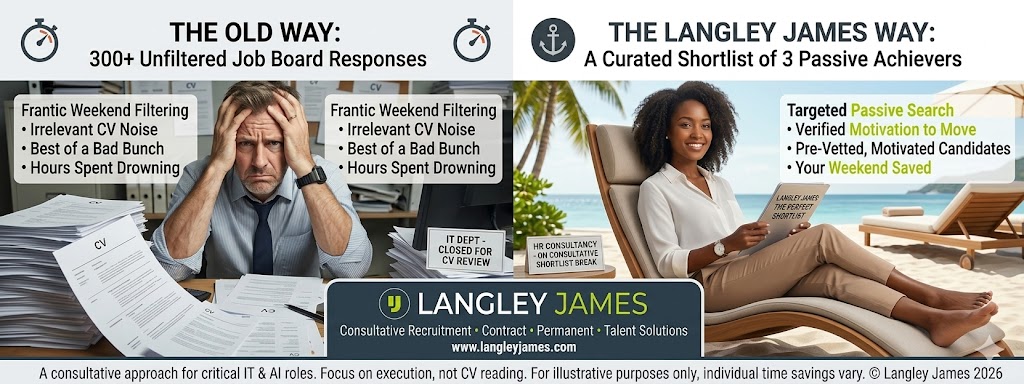
You need to fill a critical position, you post an advert online, and within 48 hours your inbox is slammed with hundreds of CVs. On paper, HR is thrilled. In reality, it’s an administrative horror show.
The vast majority of these responses yield completely unqualified, irrelevant, or unmotivated applicants. It leaves you frantically sifting through a mountain of paper, wasting hours of valuable project time. Because you’re drowning in noise, you end up compromising—settling for the best of a poor selection just to get a body in the seat.
There is a better, more civilised way to build your team.
The Best Aren’t Looking at Adverts
The best candidates, especially in fast-moving spaces like AI and advanced automation, are rarely looking at job boards. They are already busy delivering solutions. However, many are quietly motivated to move. They feel stifled by corporate bureaucracy and want a smaller, more agile environment where they can see their work implemented.
Because they aren’t actively browsing adverts, you cannot reach them by pressing ‘publish’. You can only reach them through an established, trusted network.
Deliver a Shortlist, Not a Homework Assignment
At Langley James, we have unified our entire recruitment methodology, right down to the colour palette of our final candidate profiles, around precision and clarity. We don’t just post a role and pray. We combine advanced AI sourcing tools with a rigorous, human-in-the-loop methodology and our unique Langley James ‘passive-prospecting’ technology to pinpoint the exact talent required for your project.
We do the heavy lifting so you don’t have to. Instead of forcing you to read through hundreds of mismatched profiles, we deliver a highly curated, short shortlist of exceptional individuals who are uniquely qualified and genuinely motivated.
It transforms hiring from a stressful chore into a high-confidence decision. Why spend your weekends buried under a mountain of paper when you could be relaxing, knowing the right talent is already being secured by a team that understands your brand?
Ready to skip the inbox chaos and see a curated shortlist for your next IT or AI project, delivered with on-brand precision? Get in touch with the team at Langley James for a consultative chat.
Connect with the team at Langley James today. – Click Here
Or give us a call on 020 7788 6600
Or email James@langleyjames.com
Simon: CAND18230
Dilbagh: CAND252137
M. D.: CAND252338
Why Corporate AI Strategy is Starting to Look Like a Thomas Tuchel Team Sheet
Why Corporate AI Strategy is Starting to Look Like a Thomas Tuchel Team Sheet

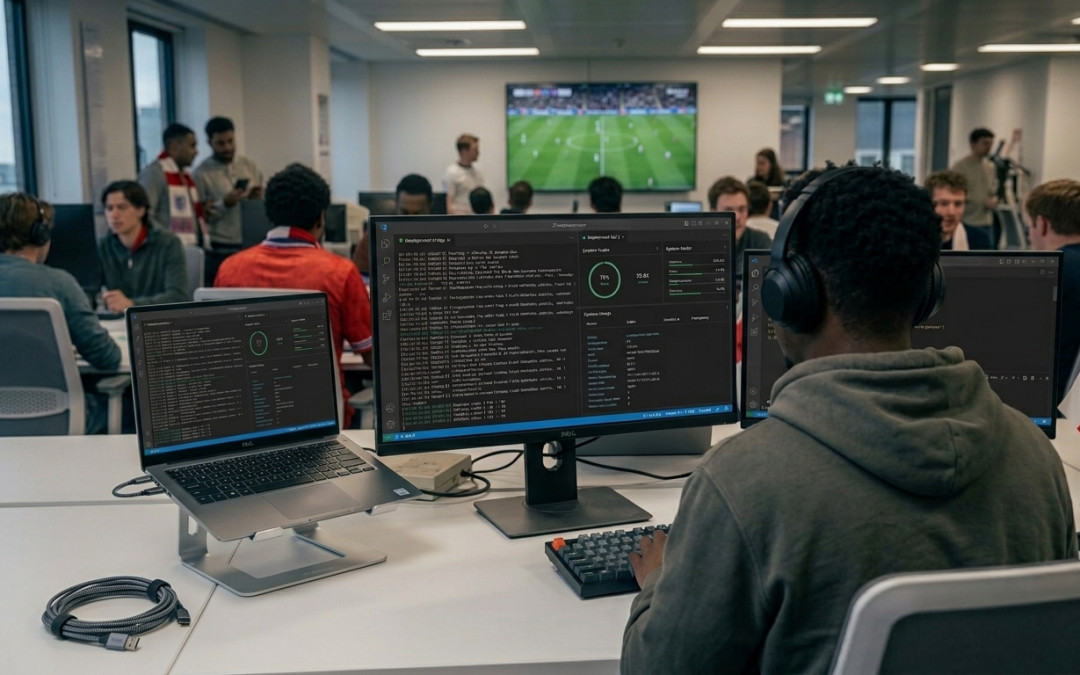
IT Dept working whilst watching England play in World Cup
Why Corporate AI Strategy is Starting to Look Like a Thomas Tuchel Team Sheet
With England’s first World Cup game kicking off today, it’s hard not to look at how boards are treating AI right now and see a massive football analogy playing out.
For the last couple of years, corporate UK has basically been acting like a football club with too much money in the transfer window. Everyone wanted the flashy, expensive players—the big Generative AI pilots and flashy front-end tools that look brilliant in a headline or a shareholder presentation.
But as we hit the middle of 2026, a lot of companies are waking up with a bit of a hangover. Those expensive pilots might look good on a highlights reel, but they aren’t winning leagues. If your backend systems are a mess, it doesn’t matter how good your front-line looks.
That’s why the smart money right now is moving away from the hype and shifting towards a proper Thomas Tuchel style of management. It’s all about tactical discipline, structure, and keeping things rock-solid.
The Tactical Switch: Midfield Generals Over Flashy Strikers
We’re seeing a massive reset in what companies are actually hiring for. The corporate world is realising that if the midfield and defence collapse, the flashy tools are useless.
The focus has completely shifted to operational stability. It’s not about finding theorists who want to talk about what AI might do in five years. It’s about finding the people who can do the hard yards today—taking secure, compliant automation and actually hooking it into the existing Microsoft stack.
Because of that, the absolute hottest profile in the London market right now is the AI Implementation Engineer.
They’re the midfield generals. They aren’t prompt engineers; they’re proper tech talent who can write clean Python, manage Azure AI, and—crucially for firms in the City—make sure everything complies with tight data governance and security rules.
The Langley James Takeaway
If you’re trying to win games with a flashy front-line but your core infrastructure is hanging by a thread, you’re going to get caught out.
At Langley James, we don’t look for the talkers; we find the human talent that actually makes these systems work safely.
If you’re hitting a brick wall trying to find the specialist engineers or contractors needed to stabilise your platforms and get projects over the line for Q3, drop me a line. We keep things simple: a fixed % fee for permanent roles, a 3-month guarantee, and a deep bench of contractors ready to step in when you need to plug a gap fast.
Enjoy the game today. Let’s hope the tactical reset pays off.
Connect with the team at Langley James today. – Click Here
Or give us a call on 020 7788 6600
Or email James@langleyjames.com
Ahmed: CAND102834
Joanna: CAND216895
Yasiin: CAND226285
Steven: CAND179833
Mounika: CAND252698
Benson: CAND252756
Apollo: CAND237165
Ben: CAND119523
Ganesh: CAND252651
Okoro: CAND252641
Ioana: CAND252690
Gurveen: CAND252751
Peter: CAND252703
Windel: CAND252702
Ike: CAND251405
Samil: CAND233482
Samuel: CAND191643
Roger: CAND237584
Jonathan: CAND179762
David: CAND123855
Niresh: CAND238606
Emmanuel: CAND225275
Gagandip: CAND140352
Christopher: CAND42763
Romayne: CAND222801
Leroy: CAND198060
Adeel: CAND244200
Rainer: CAND245188
Cory: CAND48880

Are We Reliving the Dotcom Bubble? The Frustrating Gap Between AI Capability and Corporate Reality
Are We Reliving the Dotcom Bubble? The Frustrating Gap Between AI Capability and Corporate Reality
[Estimated 1.5 Minute Read]
If you were around the tech sector in the late 1990s and early 2000s, you’ll remember the intoxicating heights of the Dotcom Bubble—and the sharp reality check that followed.
But if you look closely at the history books, the crash didn’t happen because the internet was a fad. It happened because the technology moved faster than the infrastructure and the consumer could keep up. Brilliant developers were building advanced web applications on their local networks (LANs), but the end-user was still dialling in on a screeching 56k modem.
The capability outpaced the delivery mechanism.
Fast forward to 2026, and as I speak to tech candidates every day—from brilliant, ambitious graduates to seasoned infrastructure heavyweights—I’m getting a massive sense of déjà vu.
We are facing a new kind of “Capability-Adoption Gap.” And it’s causing a quiet crisis in the tech talent market.
The Frustration on the Ground
Lately, I’ve had a string of incredibly talented AI and data engineers telling me how frustrated they are. They are entering businesses with grand visions, ready to deploy agentic frameworks and cutting-edge automation systems that they’ve built and tested.
But when they get inside, they hit a brick wall.
They encounter legacy data pipelines that aren’t fit for purpose, corporate compliance paralysis, and decision-making structures that move at a glacial pace. Their brilliant ideas end up trapped in “pilot purgatory”—stuck in endless PowerPoint decks rather than being pushed to production.
In 2026, top tech talent doesn’t just want a high salary; they want to see their work implemented. They want to see the systems they build actually driving business outcomes. When larger, rigid companies fail to provide that agility, these candidates look for the exit. They are actively migrating to smaller, nimbler businesses where they can actually build and execute.
Bridging the Gap: The Right Strategy for 2026
For businesses to survive this cycle without popping their own tech bubble, they need to close the gap between their AI aspirations and their daily corporate reality. That requires a smart, agile approach to how they resource their IT teams.
You cannot deploy the roof before you’ve poured the concrete foundations.
-
The Case for Short-Term Contractors: If your business is stuck trying to upgrade legacy infrastructure, clean up messy data silos, or get past the initial hurdle of a complex AI rollout, you don’t necessarily want to lock in permanent overheads yet. You need specialist contract talent—the architects and data engineers who can come in, build the plumbing fast, and establish organizational stability.
-
The Case for Permanent Staff: Once the foundation is laid, you need the long-term vision. Permanent IT, Tech, and AI staff are crucial to driving continuous adoption, managing workflows, ensuring strict data governance, and maintaining that vital “human-in-the-loop” oversight to ensure the tech scales safely.
The Langley James Approach
At Langley James, we balance the traditional IT operational stability that keeps businesses running with the cutting-edge tech that moves them forward. We practice what we preach—using the latest AI tools alongside deep human expertise to find the best human talent to deliver the best systems.
If you are struggling to bridge the gap between your tech ambitions and your current team’s capacity, let’s have a consultative chat about whether a targeted permanent hire or a strategic short-term contractor is the right lever to pull next.
Connect with the team at Langley James today. – Click Here
Or give us a call on 020 7788 6600
Or email James@langleyjames.com
Recent Comments