Are We Reliving the Dotcom Bubble? The Frustrating Gap Between AI Capability and Corporate Reality

[Estimated 1.5 Minute Read]
If you were around the tech sector in the late 1990s and early 2000s, you’ll remember the intoxicating heights of the Dotcom Bubble—and the sharp reality check that followed.
But if you look closely at the history books, the crash didn’t happen because the internet was a fad. It happened because the technology moved faster than the infrastructure and the consumer could keep up. Brilliant developers were building advanced web applications on their local networks (LANs), but the end-user was still dialling in on a screeching 56k modem.
The capability outpaced the delivery mechanism.
Fast forward to 2026, and as I speak to tech candidates every day—from brilliant, ambitious graduates to seasoned infrastructure heavyweights—I’m getting a massive sense of déjà vu.
We are facing a new kind of “Capability-Adoption Gap.” And it’s causing a quiet crisis in the tech talent market.
The Frustration on the Ground
Lately, I’ve had a string of incredibly talented AI and data engineers telling me how frustrated they are. They are entering businesses with grand visions, ready to deploy agentic frameworks and cutting-edge automation systems that they’ve built and tested.
But when they get inside, they hit a brick wall.
They encounter legacy data pipelines that aren’t fit for purpose, corporate compliance paralysis, and decision-making structures that move at a glacial pace. Their brilliant ideas end up trapped in “pilot purgatory”—stuck in endless PowerPoint decks rather than being pushed to production.
In 2026, top tech talent doesn’t just want a high salary; they want to see their work implemented. They want to see the systems they build actually driving business outcomes. When larger, rigid companies fail to provide that agility, these candidates look for the exit. They are actively migrating to smaller, nimbler businesses where they can actually build and execute.
Bridging the Gap: The Right Strategy for 2026
For businesses to survive this cycle without popping their own tech bubble, they need to close the gap between their AI aspirations and their daily corporate reality. That requires a smart, agile approach to how they resource their IT teams.
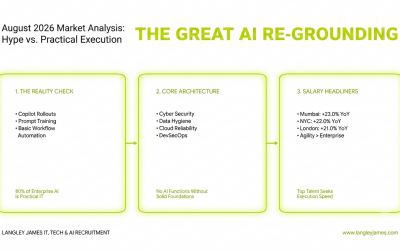
You cannot deploy the roof before you’ve poured the concrete foundations.
-
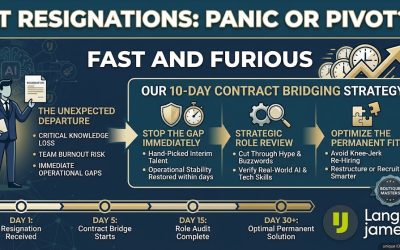
The Case for Short-Term Contractors: If your business is stuck trying to upgrade legacy infrastructure, clean up messy data silos, or get past the initial hurdle of a complex AI rollout, you don’t necessarily want to lock in permanent overheads yet. You need specialist contract talent—the architects and data engineers who can come in, build the plumbing fast, and establish organizational stability.
-
The Case for Permanent Staff: Once the foundation is laid, you need the long-term vision. Permanent IT, Tech, and AI staff are crucial to driving continuous adoption, managing workflows, ensuring strict data governance, and maintaining that vital “human-in-the-loop” oversight to ensure the tech scales safely.
The Langley James Approach
At Langley James, we balance the traditional IT operational stability that keeps businesses running with the cutting-edge tech that moves them forward. We practice what we preach—using the latest AI tools alongside deep human expertise to find the best human talent to deliver the best systems.
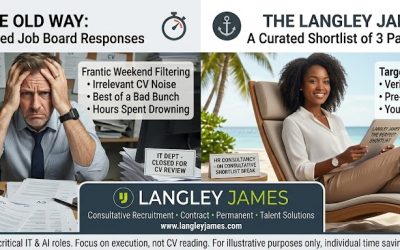
If you are struggling to bridge the gap between your tech ambitions and your current team’s capacity, let’s have a consultative chat about whether a targeted permanent hire or a strategic short-term contractor is the right lever to pull next.
Connect with the team at Langley James today. – Click Here
Or give us a call on 020 7788 6600
Or email James@langleyjames.com